
A Rare Mink Sighting
January 15, 2026
Mink (Neovision vison)
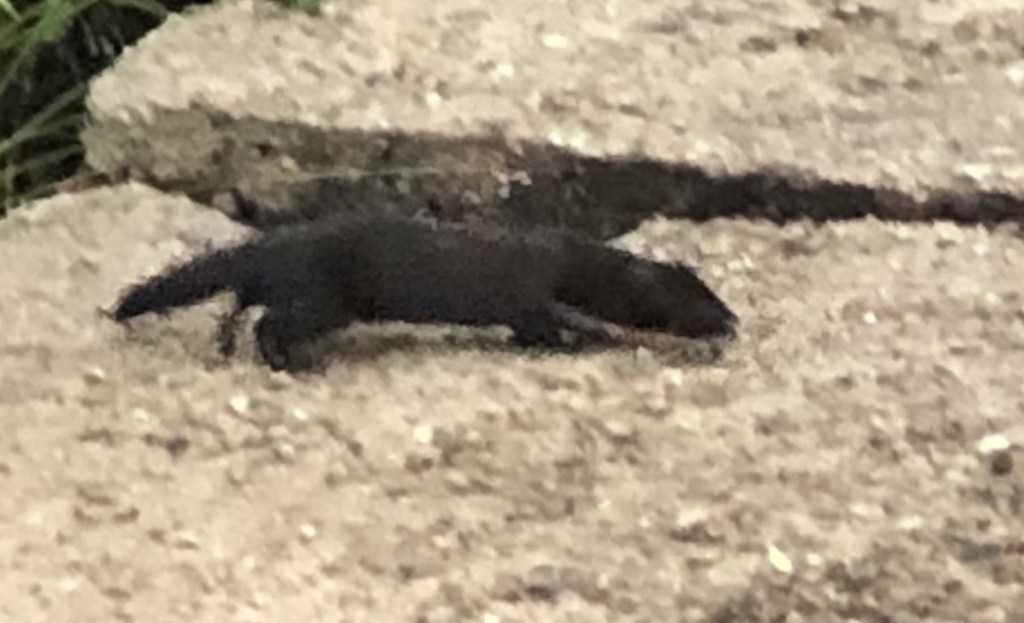
A mink was spotted on a video trail camera at King’s Landing Park! Minks are members of the weasel family and are the approximate size of a small cat. They have long bodies and short legs with soft fur covered in an oily coating to make them waterproof.
Minks are common in Maryland and spend most of their time in the water. They like to live on the edges of rivers, wetlands, or lake shores. Minks are solitary creatures and very territorial. Males will have between 1 to 3 miles of land along a water way that they consider their own and will defend it against other male minks. Females, however, are usually allowed especially during breeding season which runs from late February to April.
The presence of SAV (Submerged Aquatic Vegetation) is important to support the mink’s diet. Minks are carnivores and voracious hunters. Aquatic animals like fish and blue crabs will hang out in the SAV, which make perfect hunting grounds for minks to stalk their prey.
The Fifish ROV’s Maiden Voyage
December 18, 2025


Imagine being able to “fly” through the underwater environment, observing the otherwise invisible world that exists just beneath the surface. Some Huntingtown High School (HHS) students from Dr. Marshall Pike’s Emerging Engineers recently began a journey to explore the subsurface ecosystem using a Fifish Remotely Operated Vehicle (ROV). The Fifish is essentially an underwater drone that allows a layperson to explore environments that were previously only accessible to professional oceanographers and marine biologists. The high schoolers are working to provide our fifth-grade students with a view of the oyster reef balls placed in Chesapeake Bay as a conservation initiative.
Since 2021, Calvert County Public School (CCPS) 5th grade students have engaged in a conservation project making 250 lb. concrete reef balls to help restore local watersheds by creating structures for oysters to attach and grow and to create habitat for fish and other bay creatures. The Living Reef Action Campaign is run by the Maryland Coastal Conservation Association (CCA) and coordinated locally by CHESPAX, to engage our students in an environmental action project that ties with the science curriculum and their field trip to Fishing Creek.
The CCPS students love building the reef balls and knowing that they are making a difference in the future health of Chesapeake Bay and its tributaries. However, one request kept arising over the years, the students wanted to see what their reef balls looked like in the water. This motivated CHESPAX teacher Tom Harten to write a grant to the National Education Association Foundation for the purchase of the ROV.
On December 3rd, the HHS students took the Fifish to Kings Landing Park for its maiden voyage. Operating an ROV (Remotely Operated Vehicle) takes technical skill and an understanding of external conditions like the clarity of the water, current, tide, and obstructions. The students will train with the ROV throughout the winter with a planned deployment on Old Rock Reef near Chesapeake Beach in March 2026.
What does this all have to do with SAV? It is part of a bigger conservation picture. Oysters filter the bay, which in turn help maintain the water health of the tributaries. Having cleaner water in the rivers, creeks, and streams is beneficial to the surrounding wild and plant life. These interconnected systems depend on one another to thrive. When our CCPS 5th graders build reef balls, they are not only helping the local oyster and aquatic animal populations, but they are also indirectly making life better for the SAV.
We Have Rockfish!
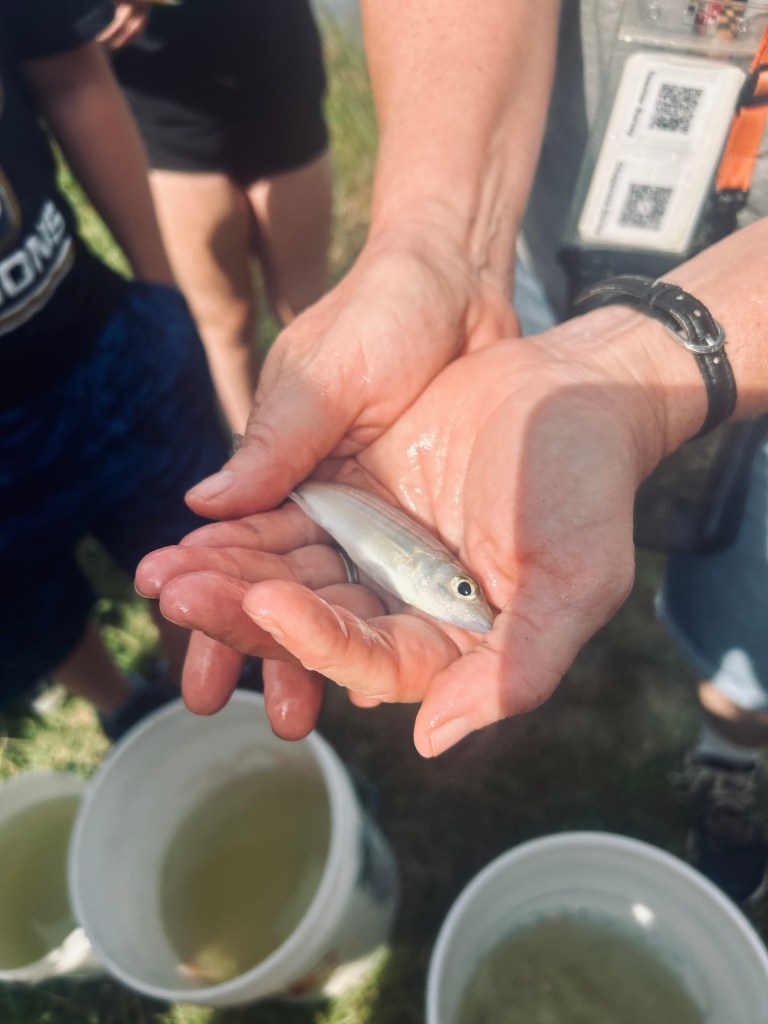
Annual surveys of the juvenile striped bass (rockfish) population in Chesapeake Bay have shown that the numbers are still lower than average. The CCPS 7th graders have collected corresponding data that supports these findings. Only a single striped bass was captured between 2022 and 2024. There are few reasons as to why their numbers have declined, overfishing, low oxygen levels, and the lack of menhaden (a staple fish for their diet).
However, this fall season the students have been experiencing a rebound in the baby rockfish numbers. So far, we have caught 13 rockfish in 21 SAV field trips! This information could possibly predict a surge in the striped bass population in the Patuxent River. The team at CHESPAX will continue to monitor this new development, keeping our fingers crossed that the conservation efforts Maryland has enforced to correct the striped bass deficit are working.
It’s Been 25 Years!!
September 10, 2025

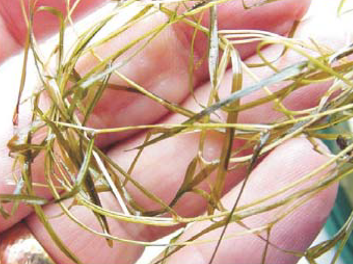
Southern Naiad is back!! After a 25-year hiatus, the CCPS students raked up a few samples of the species last spring. We have been out four times this fall season and have already found it twice! What is happening? How can a plant that has not been seen in 25 years suddenly make a comeback in Cocktown Creek? There are a few possible explanations.
What we know is that there are various contributing factors to SAV survival. Perhaps the water conditions like salinity and temperature are now optimal for the Southern Naiad to thrive? We have seen a dramatic reduction in the amount of non-native Hydrilla growth in the creek. This species once formed dense beds that covered the surface of the creek. This blocked the sunlight from reaching other species attempting to grow in those areas. The loss of these Hydrilla beds has allowed more sunlight to reach the bottom of the creek. This may be providing a window of opportunity for other species to return to Cocktown Creek.
Could Southern Naiad benefit from these recent changes in the creek? How did these new plants return after an absence of 25 years? It could be that a piece of Southern Naiad from another area was swept into the creek during a high tide and replanted itself. This growth by “fragmentation” is common in this species. Another possibility is that some Southern Naiad seeds were lying dormant in the mud just waiting for the right moment to sprout.
The fact is that we may never know the exact reason why it has returned, but what we do want to impress upon our students is that SAV is RESILIENT. Many changes have occurred in the 30+ years that the CCPS 7th graders have been studying Cocktown Creek, and the re-emergence of Southern Naiad is proof that SAV can withstand the tests of time. This also underscores the importance of the regular monitoring of SAV in Cocktown Creek. The data collected by our students helps tell the ever-changing story of our creek ecosystem. Who knows, maybe in future seasons we will see Wild Celery growing again? Wouldn’t that be a fantastic story to be able to tell?!!
Season Summary
June 12, 2025
The Spring 2025 SAV season was a very short one with only 17 field trips. However, even with the weather not always cooperating, we finally managed to finish out the season strong. The wildlife was in abundance and the tide cooperated, all in all, our season was great. The 7th graders impressed us with their adaptability and willingness to work hard in the name of science.
This spring, our students located 7 species of SAV in Cocktown Creek, collecting coontail, hydrilla, horned pondweed, common waterweed, southern naiad, naiad species, and curly pondweed. Finding SAV in early spring can oftentimes be more challenging since the plants are very small, but there was only one time when a team came back empty handed.
We had some fantastic seine hauls too. Seining is an important part of the bigger SAV picture. The species caught gives us perspective on what might be feeding or dwelling in the SAV. These aquatic animals spawn in the Patuxent River and surrounding watersheds. The more diverse the species, the healthier the habitat is.
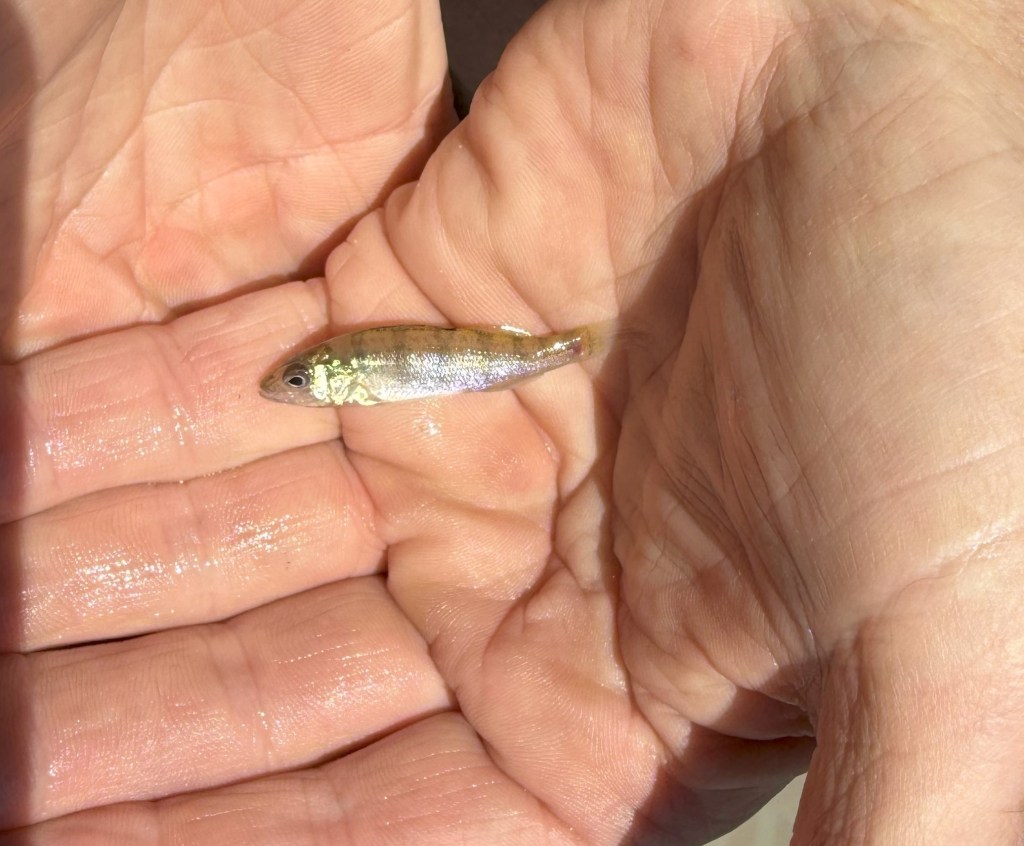
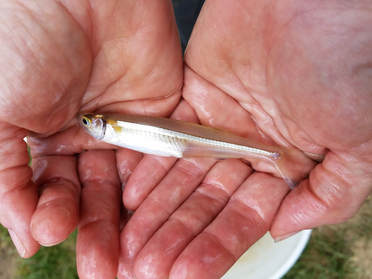
On May 23, students in Mrs. Liston’s class caught a tiny yellow perch. Yellow perch spawns in the spring and are found in rivers, lakes, creeks, and streams. They are very pretty with a yellow-greenish body and 6 to 8 darker vertical stripes. They do not get very big, usually up to 12 inches in length, but they are delicious and so a favorite for fisherman. Normally a freshwater fish, yellow perch are adaptable and can withstand a bit of saltiness in the brackish waters of the Patuxent.
Look at the catch by Mrs. Liston’s students!
We are “Egg”static!
May 2, 2025
We have eggs! That’s right, our osprey couple has produced 3 beautiful eggs. Typically, a female osprey will lay between 3 to 4 eggs in one clutch but, the interesting part is that the eggs are not laid all at once. Instead, an egg is laid every 1 to 3 days until the clutch is complete. Each egg will take approximately 35 to 43 days to develop and then the eggs will hatch at different times. This gives the older chicks an advantage, and in the osprey world the nest becomes a very tenuous place that gives a new meaning to the term “sibling rivalry.” Not only do chicks have to be wary of outside predators, but they also must deal with their older siblings who are generally bigger and more aggressive. In some cases, the older chicks can injure or kill the younger ones by pecking them or blocking them from food. Though sad, it’s the natural way of things in the nest of raptors.
Osprey eggs are very beautiful and slightly larger than chicken eggs. Generally, creamy in color with reddish brown mottled spots.

Please check out our osprey in Cocktown Creek at the link below!
https://player.brownrice.com/embed/chespaxospreycam
Spring 2025 SAV Season is Here!
April 7, 2025
The 2025 spring SAV season is here and though the weather has been fickle; 3 classes have already been on the field study. So far, each trip has yielded some terrific observations and SAV finds.
The students witnessed the ospreys collecting nesting materials and fishing in the river and creek. Some students in Mr. Kohan’s class saw a muskrat swimming near marker 0. Mrs. Payne’s class was the only one to score a bald eagle sighting, and Dr. Macauley’s students observed a black rat snake infiltrating a wood duck nesting box.

Each class was also able to get some samples of SAV, which can be a difficult task in the early weeks of April. The SAV is very small and sparse, so we have been lucky to have collected horned pondweed, coontail, and some hydrilla. The one advantage of spring observations is that the new SAV growth is green in color and stands out against the dark brown marsh mud.
We have 16 more trips on the docket, and we look forward to what are students will discover, determine, and document!
It’s March! Do you know what that means??!
March 7, 2025
The return of March means the return of the osprey for coastal Maryland! Osprey are migrating back from South America to resume their place at the top of the food chain. Heavily populated in the Chesapeake Bay area, osprey will reinhabit the nests that you can often see atop of water platforms, in trees, and wherever there is a tall spot that is close to the water. These raptors survive mostly on fish, which is why they can be referred to as fish hawks in some regions.
Every year CHESPAX participates in a friendly competition, where each member of the team takes a guess at what day our osprey pair will return to the nest. The winner gets bragging rights for the rest of the CHESPAX season. Reports of osprey sightings have already been made along Maryland’s coastline, so we are expecting them to make their 2025 spring debut any day now.
Last season our osprey pair did not lay any eggs in the nest. So, it begs the question, could this be the year? I know that we are super excited to see what happens and can’t wait to hear all the observations that our CCPS 7th grade students make while watching our Cocktown Creek osprey couple live on camera.

Species Spotlight: The Double-crested Cormorant
February 5. 2025

Double-crested Cormorant Audio:
https://search.macaulaylibrary.org/catalog? taxonCode=doccor&mediaType=audio
The Double-crested Cormorant is a bird that is regularly seen on our SAV fieldtrips. There are six different species of cormorants in North America, but the Double-crested is the most common. Cormorants can be mistaken for loons because of their similar dark plumages, but interestingly they are a relation to the pelican.
This large waterbird can grow up to 35 inches in length and has a wingspan of approximately 52 inches. It has a hooked beak, which is designed for catching fish and orange-yellow skin around the base of its beak and on its chin. For a bird that spends so much time in the water their feathers are not waterproof. One can often see cormorants standing with their wings spread wide. This is the preferred method for drying and regulating their body temperature after a swim.
A unique feature of the Double-crested Cormorant are its eyes, which are adapted to see both above and under the water. As expert divers, this is an important feature. They can dive under the water up to 150 feet to get their prey. During breeding season, their eyes turn a vibrant teal in color.
Cormorants are quieter birds, but when they communicate it is with a gravelly croaking sound. They nest in trees, sea cliffs, or grounds near the water. Their poop is so acidic that it can kill the surrounding trees and plant-life.
Check out Mr. Harten’s experience with Red-faced Cormorants in Alaska!!
4 August 2009 Red-faced Cormorants | PolarTREC


That’s a Wrap for 2024 Stream Surveys!
December 10, 2024
Stream Survey’s for the 2024 year are complete and if you ask CHESPAX the students “Snail-ed” it!!
Stream Surveys are the culmination of the CHESPAX experience where the students are asked to finalize their investigation of our local watersheds. In 7th grade, the CCPS students conduct a field study in Cocktown Creek to determine if the water conditions are suitable for SAV (Submerged Aquatic Vegetation) growth. Stream Surveys move the study a bit further into the watershed to record macroinvertebrate biodiversity. The more diverse the bugs, the healthier the stream is.
CHESPAX sets leaf packs into accessible streams located within that schools’ watershed. The leaves are then brought to the school for the students to explore nature within the classroom.
We had some very exciting finds this year. Two very cool macroinvertebrates that are note-worthy were a crayfish and a caddisfly.
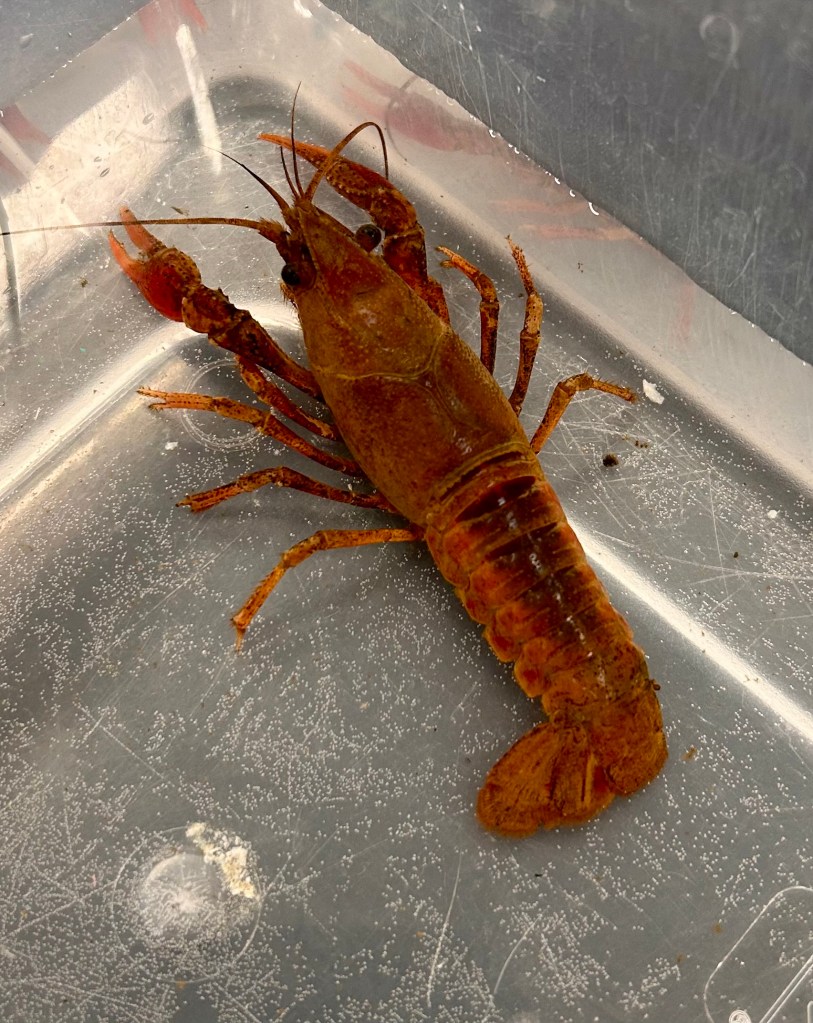
The largest crayfish in 10 years of the program! Mr. Fluharty’s students found a crayfish almost large enough to eat!
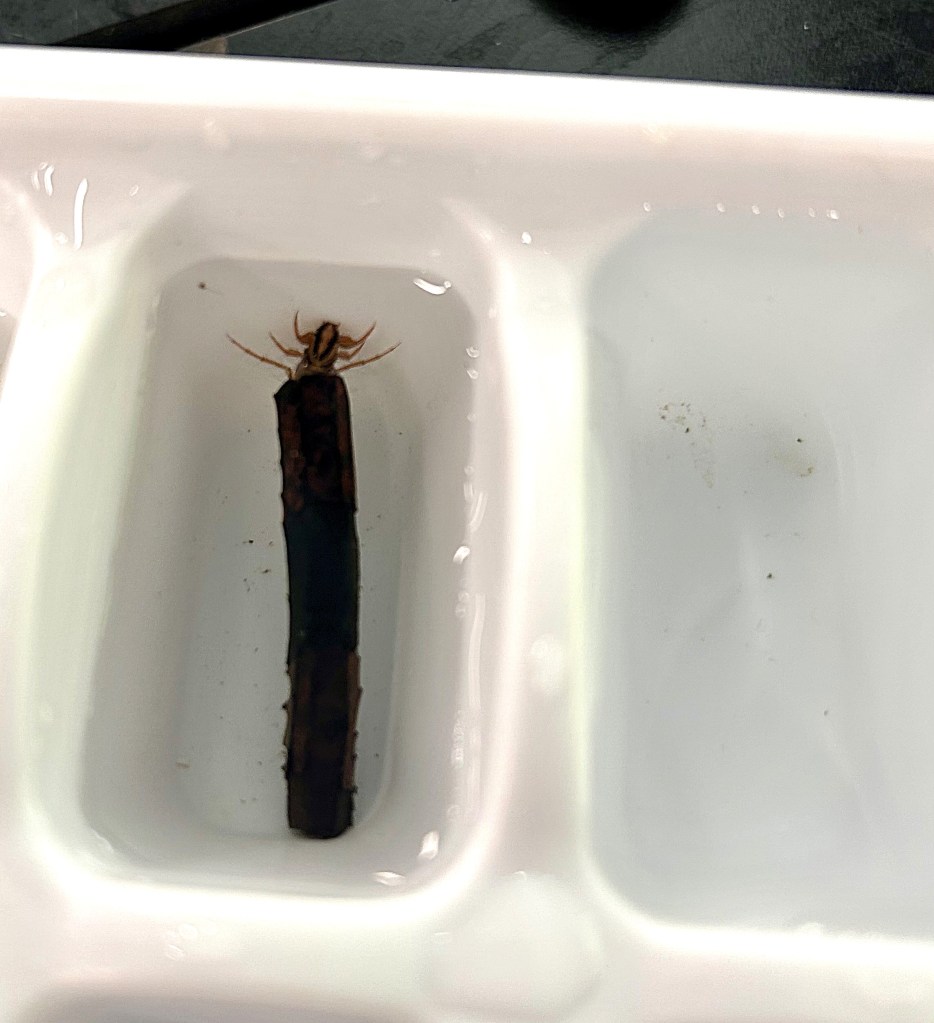
A beautiful caddisfly! This caddisfly was found by students in Dr. Price’s class, and it had made its home out of a leaf. This was the biggest caddisfly of the year.
Fall 2024 SAV Data
Four species of SAV were surveyed this Fall season: Coontail, Hydrilla, Naiad, and Common Waterweed. The 7th grade students had great success finding Hydrilla 94% of the time, and Coontail coming in a close second at 91%. Naiad was also quite frequent for all of September but ended up thinning out toward mid-October possibly due to the lack of rain. Naiad Species prefer fresh-water environments, and no rain can mean an uptick in salinity.

Sheepshead Minnow
October 29, 2024
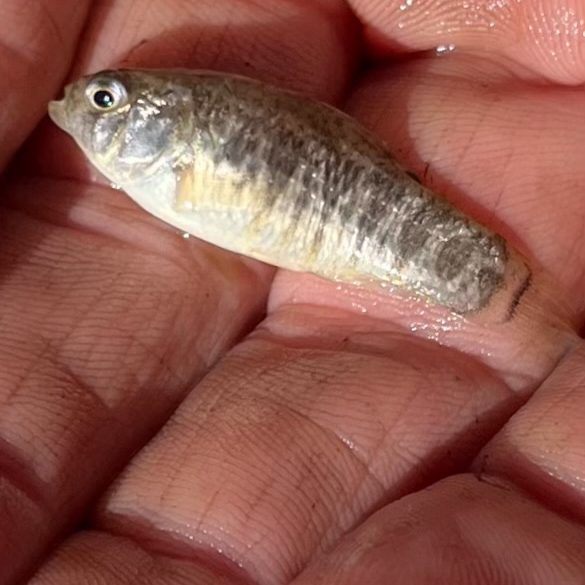
Two Sheepshead minnows were seined this Fall SAV season: one from Mr. Kohan’s class at PPMS and one from Ms. Fallica’s class at CMS. We catch very few sheepshead minnows, so we were excited when the students pulled them out of the Patuxent.
Sheepshead minnows are as wide as they are long and can sometimes be mistaken for mummichogs. Their bodies have an olive-green color with a tinge of yellow on the bottom. Juveniles have irregular transverse dark bars that females keep these as they mature, while the males lose theirs. They have very sharp teeth because they are omnivores that feed mostly on detritus (dead organic material), small invertebrates, and microalgae.
One interesting fact is that sheepshead minnows make good aquarium fish because they are easily bred in captivity.
Muskgrass…Algae that looks like SAV
October 11, 2024
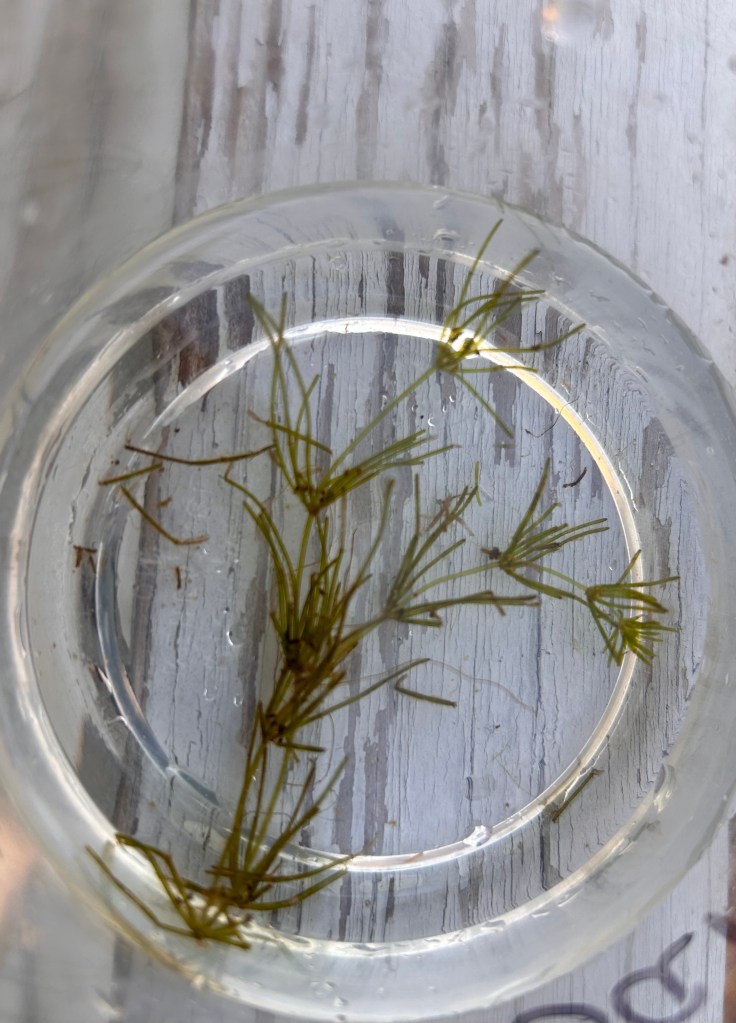
The CCPS 7th graders from Mr. Pellock’s class at PPMS and Ms. Fallica’s class at CMS were left scratching their heads when they raked up what looked to be a new species of SAV for the Fall 2024 season. Each class had students rake up what looked like SAV, but was actually a form of algae called Muskgrass or Chara. It was tricky to identify because it could be mistaken for Naiad species if not familiar.
Muskgrass is a multi-cellular algae that is grayish green in color. It has a musty, undesirable smell, hence its name. There are no roots or leaves, but it has numerous spiny-like branchlets that attach around a node and it prefers to grow in alkaline waters that are brackish or fresh.
Muskgrass contributes positives and negatives to its environment. It can be a delicious snack to local waterfowl and a nice hiding place for small invertebrates and small fish. However, if it becomes overgrown, muskgrass can steal the sunlight from important SAV plants and impact SAV growth.
Compare the pictures below and see if you can tell the difference between muskgrass and naiad species.

Mrs. Payne’s Awesome Seine
October 1, 2024

The Striped Bass “Rockfish”
The Striped Bass, also known as Rockfish, is Maryland’s state fish. Commercial and recreational striped bass fishing contributes greatly to Maryland’s economy bringing in millions each year. The Chesapeake Bay and its tributaries are one of the largest spawning areas for the striped bass population. However, the last few years have brought emergency regulations in Maryland imposed to increase the protections of this coveted fish. These regulations help the fish survive to older age classes by stopping it from being over-fished.
The last striped bass on the CHESPAX record was seined by Mr. Mower’s 7th graders on October 22, 2022. For 2 years the rockfish remained elusive. Questions emerged like was there change in water conditions, a lack of food, or a variation in migration patterns? It’s hard to know. Fortunately, our luck improved when Mrs. Payne’s class fished not one, but two rockfish out of the Patuxent on September 13, 2024. This was an exciting catch indeed!
The striped bass is an anadromous species. This means that it lives in the saltier water of the Chesapeake Bay and the Atlantic Ocean for most of its life, but spawn in the fresher tributaries of these larger bodies of water. The name “rockfish” is derived from the oyster rock or reef where these fish can be found, and they prey upon smaller fish and crabs to eat.
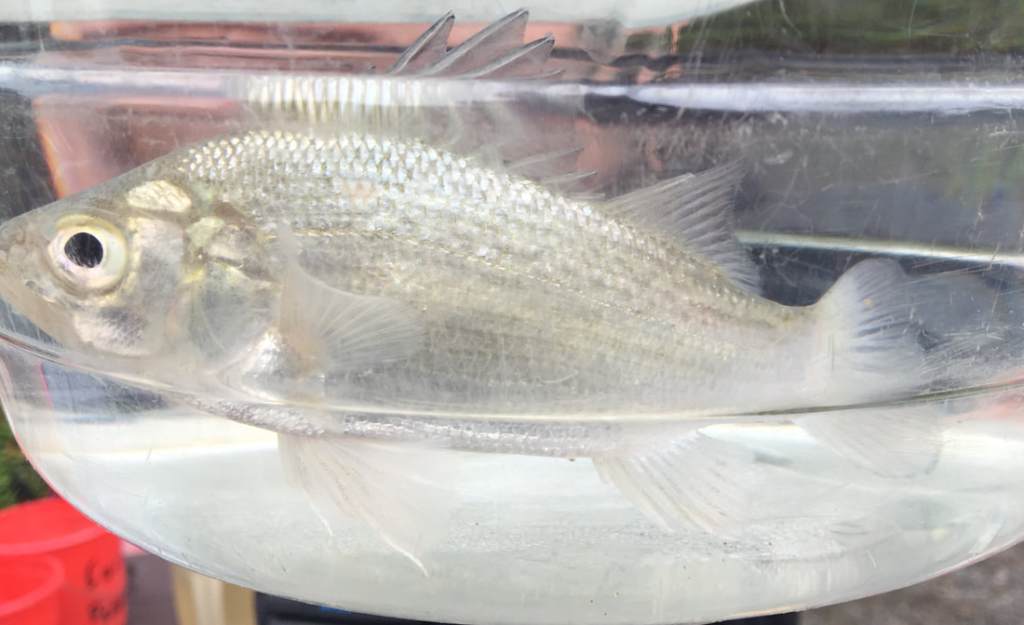
Striped Bass caught at King’s Landing are typically very small, usually less than 10 cm in length. They are fast swimmers and can be identified from their relative, the White Perch, by their more streamlined body and a distinct, horizontal striping that runs along its side.
Way to go Mrs. Payne’s class for a great find!
New School Year = Fall SAV Season = Woo Hoo!
August 29, 2024
Summer is winding down and the CHESPAX team is eager to begin a new SAV season with the Calvert County Public School 7th graders.
The SAV field study is an incredibly unique program because it is approximately 30 years old. CCPS students have been participating in one of the longest running SAV studies in the Chesapeake Bay Region. In some cases, parents who now attend as chaperones for the trip were once students who participated in the SAV field study. The program has come full circle and is now generational, which is very special.
Determining the health of Cocktown Creek is important to ensure that our local watersheds provide enough resources for the wildlife that inhabits our local area. The students conduct observations and tests to establish the biodiversity of the SAV growth, the animal population, and the general condition of the water. The students learn about conservation and how certain changes in the surrounding environment can affect the water quality, which in turn can change the growth of native plants, animals, and aquatic life.
CCPS students are in for an exciting SAV season! The CHESPAX team conducted their annual pre-survey of Cocktown Creek and were pleasantly surprised to find an abundance of one species of SAV. We do not want to ruin the surprise, so there will be more to come in future blogs but let us just say that there has been a surge of growth, and we hope to find several different species of SAV this season.


Spring 2024 SAV Data
May 31, 2024
The Spring 2024 SAV season is over and CCPS is nearing the end of the school year. We only had 19 7th Grade SAV canoe field trips and it went by in a flash! The students gathered 5 species of SAV during the season: Horned Pondweed, Curly Pondweed, Hydrilla, Coontail, and Common Waterweed. With Horned Pondweed being the most surveyed at 86%.
One observation is that the SAV growth seemed to be less abundant in Cocktown Creek than in past seasons. Our water samples indicated average salinity and algae levels, so it is reasonable to say that those factors didn’t inhibit growth. However, there could be other factors like nearby building/land alterations, farming pesticides/pollutants, or just a natural change in growth with a slower start. It will certainly be interesting to see what the SAV will look like in the Fall and reminds us of why this 7th grade field study is so important. The conditions are ever changing!

Bojazi’s Bluegill
April 19, 2024
The Spring 2024 canoe season has begun and so far, the wildlife sightings have been most impressive. Out on the Patuxent, there has been some epic osprey and eagle action. We have also seen great blue herons, cormorants, wood ducks, kingfishers, yellow legs, water snakes, and red bellied turtles. These animals are good indicators that life within Cocktown Creek is thriving.
Another way we determine the health of the ecosystem is by seine hauling for aquatic life. Patterns have already started to present with consistent numbers of bay anchovies, blue crab, mummichogs, inland silversides and spot-tailed shiners.
On April 9th, Mr. Bojazi’s 7th grade class had a group of students who seined a Bluegill Sunfish. We haven’t caught a bluegill in a few years, so that was an exciting moment. Bluegills are a compressed, oval-shaped fish with a small mouth and a spiny dorsal fin. The upper portion of the body is olive green, and the bottom half can be a light orange or yellow. Bluegills have a purple-blue iridescence on their cheeks, making them distinctive. Generally, they like to be in freshwater and can be found in many Maryland tributaries. Our water testing results have confirmed that the salinity level in Cocktown Creek is averaging between .1 and .3 ppt. With barely any salt in the water, the conditions are just right for this species.

It’s been a great start with our first 5 trips, and all signs point to an abundant SAV season! The CHESPAX team is excited to gather more data and experience some more awesome wildlife with the CCPS 7th graders.
An Eagle Helping the Ospreys!
March 4, 2024
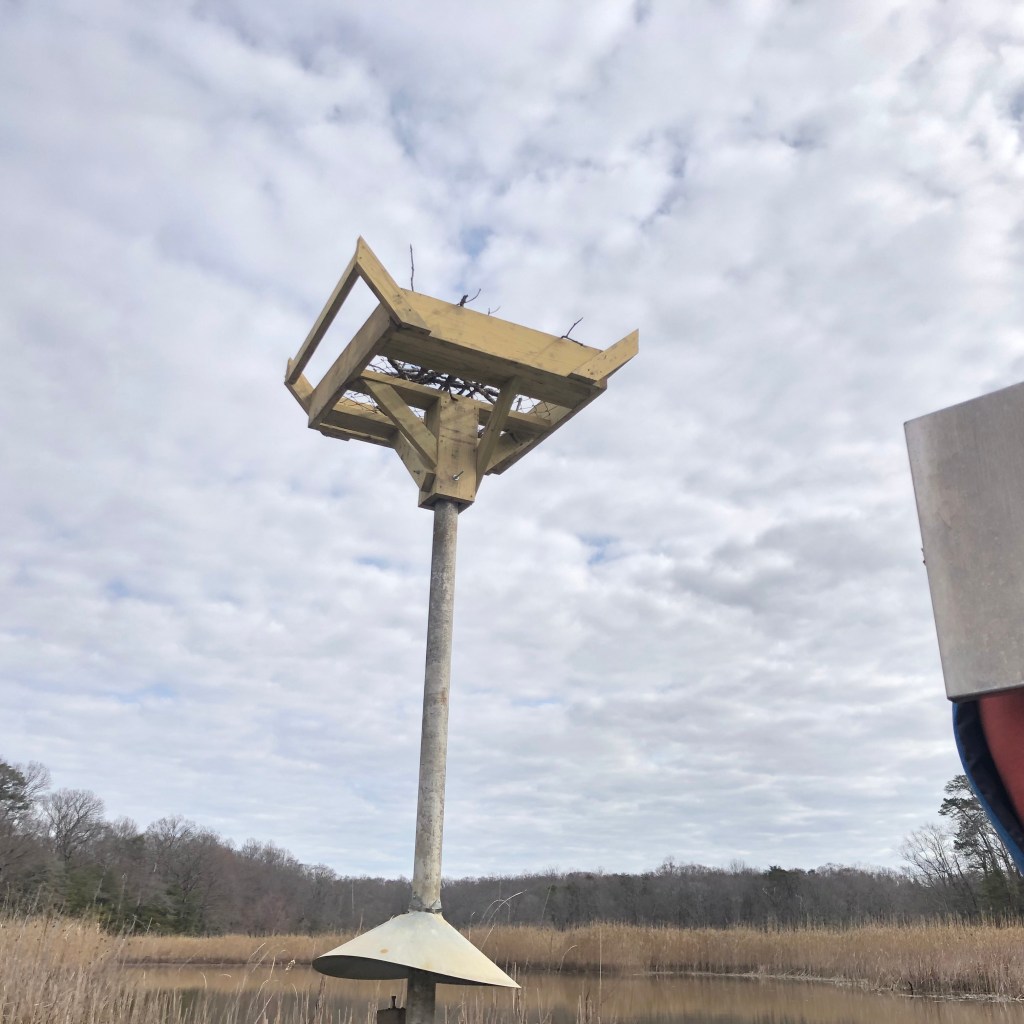
There are many reasons to be excited to see the ospreys return from their wintering grounds in South America. This year, we are especially excited that there is a brand-new nesting platform waiting for them! We are eager to see how they take to their potential new home. Many thanks to Hank Valentin and scouts from Troop 430 for constructing our new osprey platform! Hank completed the project as a part of his work towards receiving his Eagle Scout Award. Congratulations on a job well done!
Last year, the osprey pair abandoned their nest because the platform was too low to the ground, so it is with high hopes that they will re-build on the new platform.
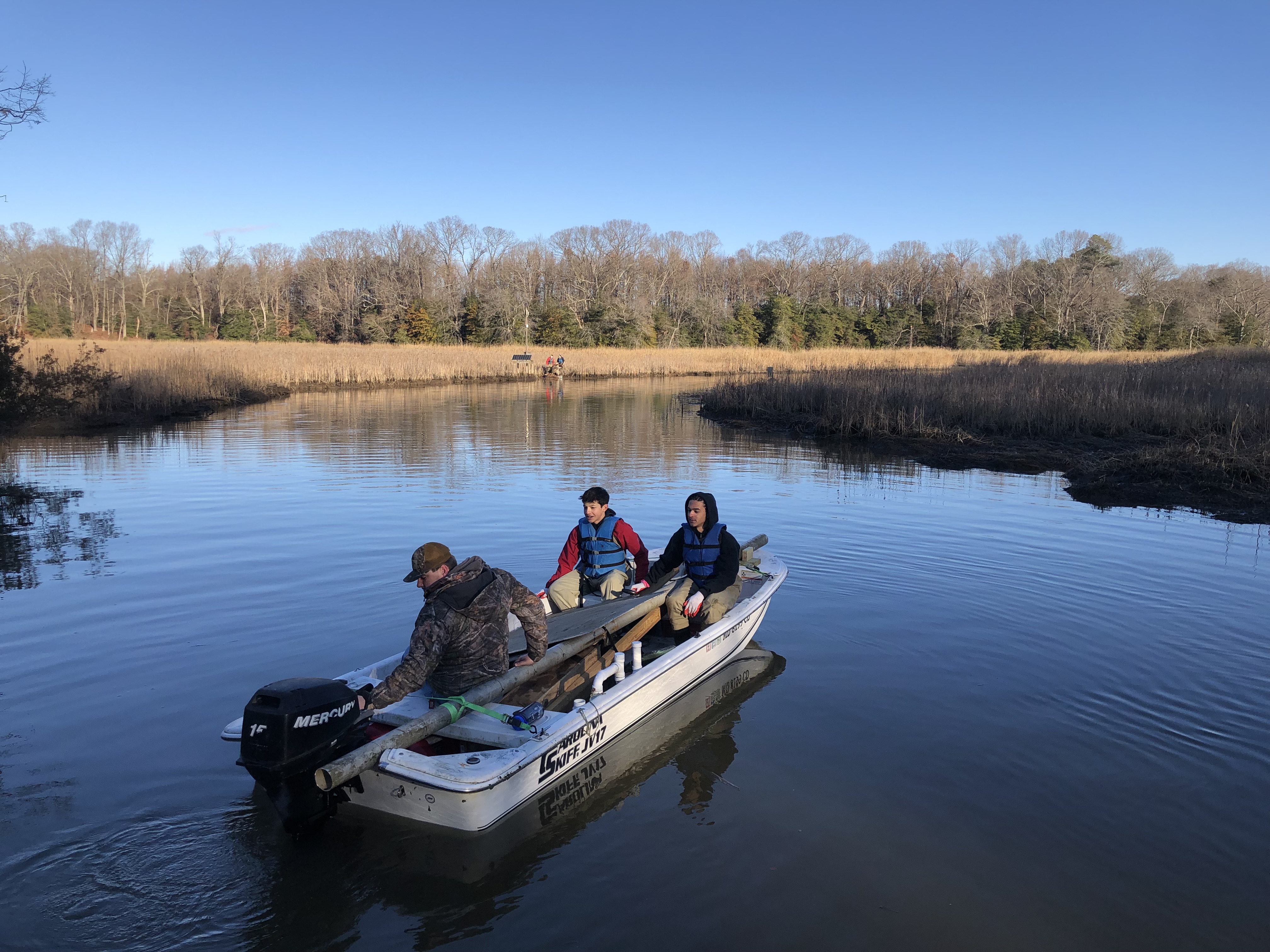
The CHESPAX team successfully installed the osprey camera battery today and the video stream is now LIVE! This process involves waiting for high tide, hiking a canoe through the woods and onto the boardwalk, and dropping the canoe into Cocktown Creek to access the camera array.
The livestream camera is located above their nest, so that our students can monitor the ospreys in their natural environment. However, anyone can access the livestream by Osprey Cam link!
https://www.ipcamlive.com/chespaxosprey
Please be sure to check in on a regular basis to watch our osprey family from the creek.


Horned Pondweed (Zanichellia Palustris)
February 29, 2024
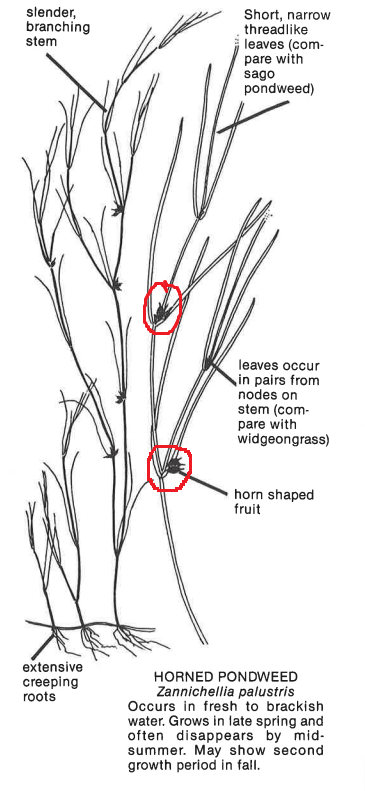
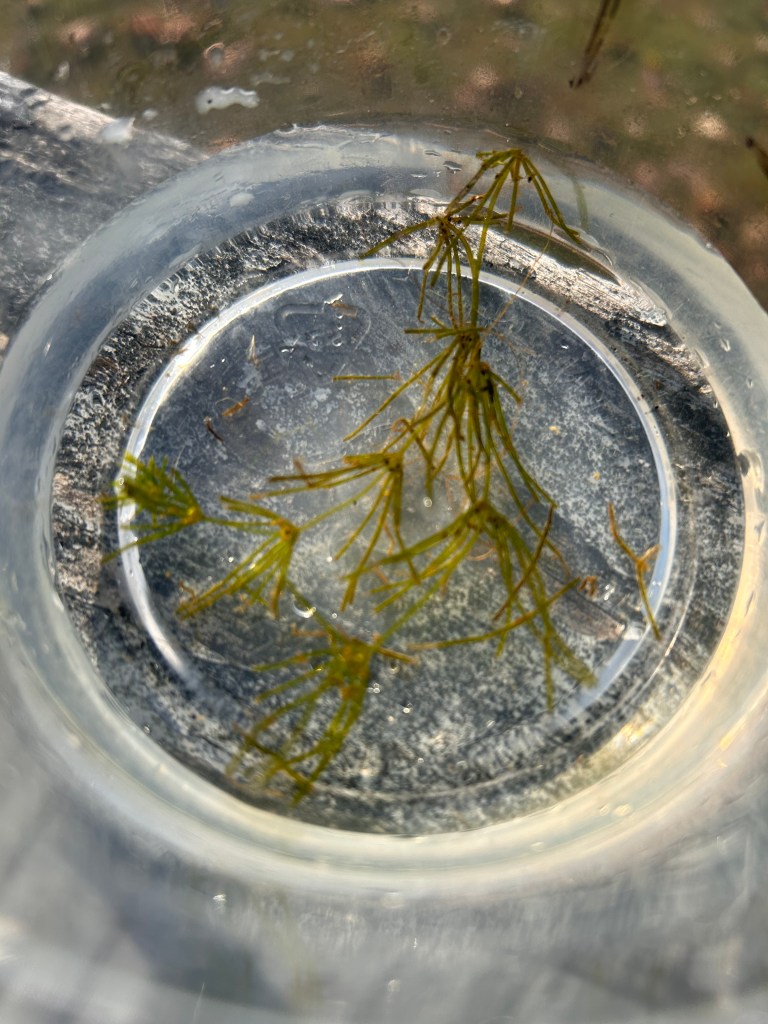
The CHESPAX team is gearing up for another Spring SAV (Submerged Aquatic Vegetation) season with the Calvert County Public School’s 7th graders. There are several species of SAV that can be found in Cocktown Creek during the spring. One species of SAV that is normally prevalent in high numbers early in the season is Horned Pondweed.
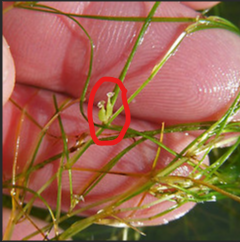
Horned Pondweed is very similar to Slender Pondweed but has an important difference. The leaves on Horned Pondweed grow in clusters opposite one another on the stem and it has “horn-like” seeds that grow between the leaves and the stem during the late spring. Because Horned Pondweed is comparable to Slender Pondweed when flowers and seeds are not present, this is a tricky SAV species for 7th grade students to identify.
Last spring, we completed 46 surveys. The students were able to find Horned Pondweed samples 97% of the time. There was one testing area between markers 1 and 2, where they were unable to locate Horned Pondweed. Between those specific markers, the bottom of the creek is not as flat, and the water is deeper. Both factors make this area not as hospitable for SAV growth.
Compare the photos below:


Boy Scouts Build a Home
January 10, 2023

Imagine returning from a 3,000-mile journey to discover that your home was in danger of disappearing! This daunting scenario was a reality for the osprey pair that nest near the CHESPAX office on Cocktown Creek.
Every March for the last 20 years, ospreys have returned from South America to the platform that was built especially for them to nest upon during the warmer months. Over time, the platform began to sink lower and lower into the creek bed, creating an unsafe situation for the ospreys. Being so close to the ground makes them more vulnerable to predators.
In the spring of 2023, the ospreys decided to abandon the nest that they had built on the subsiding platform and began to create a new nest right on top of the CHESPAX webcam used to monitor their nesting progress! The conditions were not ideal, and the nest was never a successful venture for the osprey. Also, our nest-cam didn’t have any activity to livestream to the students, which was disheartening.
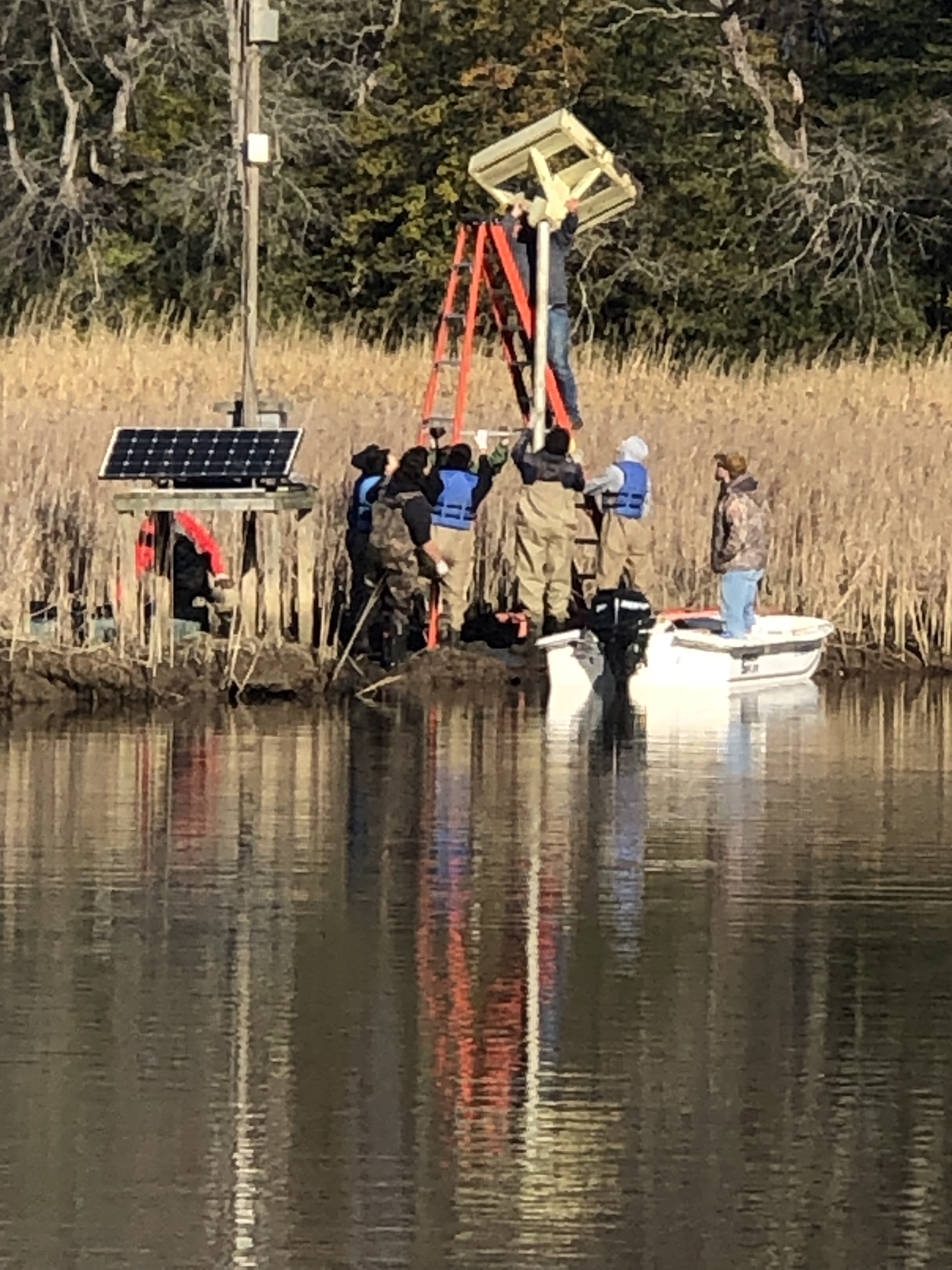
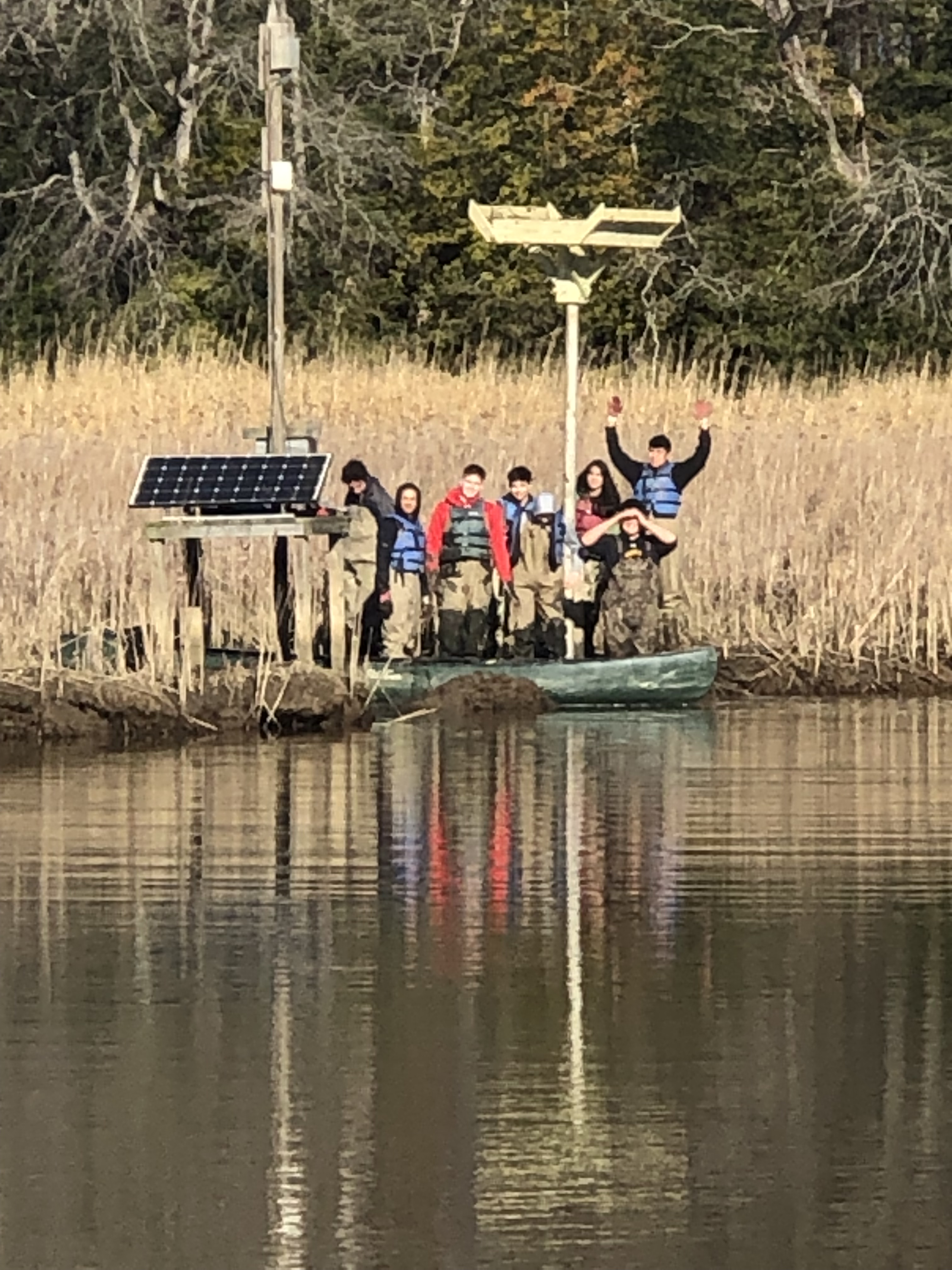
Cue the Boy Scouts! The CHESPAX team inquired about having the scouts build another platform, so that the osprey could once again have a safe and stable place to nest. Hank Valentin, an aspiring Eagle Scout, reached out with interest and the plans were in the works. On December 30th, an organized team of Boy Scouts spent a sunny morning in the marsh to assemble and situate the brand-new platform for the ospreys. The success of the project left everyone excited and beaming with a sense of accomplishment.
The only thing left is for the osprey to make their return journey to Cocktown Creek. We are looking forward to the privilege of being able to observe these majestic birds both online and on future field trips with our students. The CHESPAX staff is so grateful to Hank for adopting this project, which will be enjoyed for many years to come!!

The Beautiful Belted Kingfisher
December 19, 2023

Out of all the wildlife sighted on the CCPS 7th grade SAV (Submerged Aquatic Vegetation) field trips, my favorite is the Belted Kingfisher. This stocky bird has a spiky feathered head and is usually heard before it is seen. The chipper chattering echoes throughout Cocktown Creek bringing a momentary burst of excitement to the students and chaperones when they swoop by in energetic flight.
The Belted Kingfisher has distinct markings. Both males and females have a blue-gray band across their chests, white collars, and white specks on their wings. Uniquely, female Kingfishers also have a rust-colored band, which makes them more vibrant than the males.
Kingfishers survive by eating small fish, mollusks, insects, crustaceans, mammals, and other birds. This is why they are an integral part of the Cocktown Creek ecosystem. The SAV on the bottom of the creek provides food and shelter for various species of aquatic life. Experts at diving, Belted Kingfishers have a surplus of available food opportunities when SAV is plentiful.
Kingfishers are closely associated with magic and folklore. In many Native American cultures, the Kingfisher is seen as a sacred bird. Commonly used as a symbol of adventure, courage and perseverance.
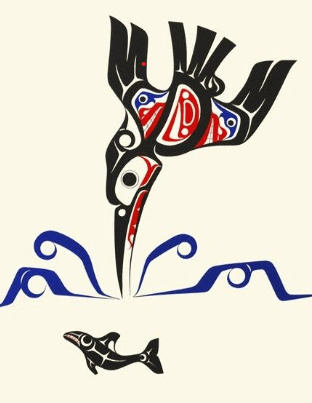
Native American Totem Art
Written By: Jenna Lyons
Fall 2023 SAV Data
November 21, 2023
It was a wonderful SAV season in Cocktown Creek with cooperating weather and lots of SAV. Hydrilla and Coontail were the most prevalent species, but we were pleasantly surprised by the amount of Common Waterweed that was surveyed. It seems like this plant is making a comeback in the creek!
Interestingly enough, the students found two different types of Naiad on earlier trips in the season, but its presence seemed to die off once the water temperatures dropped.

Ophelia and the Spotted Sea Trout
October 17, 2023
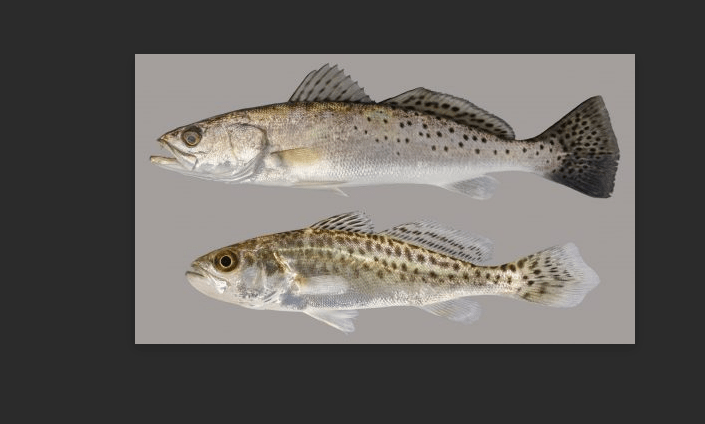
On 9/27/2023, Mr. Pellock’s 7th grade science class seined the very first Spotted Sea Trout that CHESPAX has on record. The CHESPAX team haven’t seen a Spotted Sea Trout in at least 25 years of instructing the SAV program. This was a special catch that could have been linked to the post-tropical cyclone Ophelia, which impacted the Chesapeake Bay area on the third weekend in September.
With the high winds and heavy rain, lots of coastal areas were flooded. The direction of the storm caused higher tides and increased salinity levels in the bay’s surrounding tributaries. This is a possible reason why the Spotted Sea Trout was found that far into the Patuxent River.
The Spotted Sea Trout is not actually a trout, but a member of the drum family. They are most abundant in the mid-Atlantic and southeastern regions of the United States and prefer salinity levels between 5-35ppt.
Local fishermen also reported the presence of Red Drum off the King’s Landing Pier. This is also an uncommon species in the river and is further evidence of higher salinity levels caused by Ophelia. Witnessing new varieties of fish during seine hauling generates excitement during the SAV field studies and leaves the students questioning what other species there are to discover in the Patuxent.

Take it With a Grain of Salt
September 20, 2023
The CHESPAX team is back out in Cocktown Creek with the Calvert County Public School 7th graders to monitor the SAV (Submerged Aquatic Vegetation) for the Fall 2023 season. The first two canoe trips were strenuous because of the high temperatures, but the students succeeded in obtaining the SAV and water samples needed for the overall data collection.
One of the water quality tests the students conduct is the amount of salinity in the creek. The students use a measuring tool called a hydrometer to get an accurate reading. What the students found is that the salinity levels in the creek were the highest they had been in years, averaging 6 PPT!! This is way more than the normal average of .5-2 PPT. It was up to the students to ascertain what abiotic factors contributed to this substantial increase in salt.
At the end of our class, the students correctly determined that more rain would dilute the creek causing lower salinity. Since it has been a hot, dry summer the salinity level rose by several PPT, which can make the environment unfavorable for SAV. Fortunately, the conditions of the creek change quickly, and the salinity levels returned to normal within a few days.


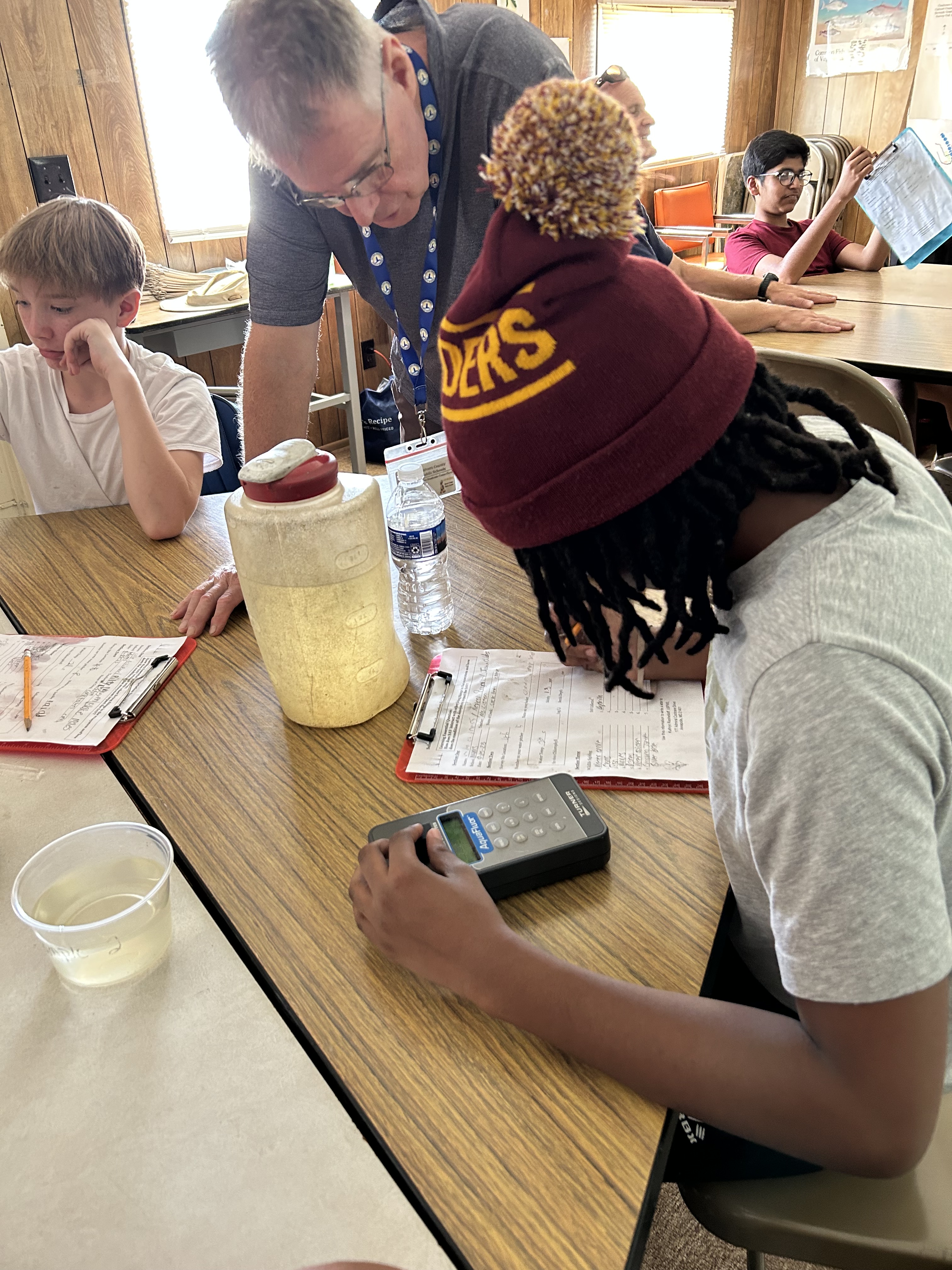
Students from WHMS testing their water samples with the CHESPAX hydrometer.
A Rare and Delightful Seine Haul
April 28, 2023
On April 27, 2023, Windy Hill Middle School 7th graders were able to observe a unique event during one of the seine hauls on the CHESPAX canoeing field trip. After the students walked the fishing net to the shore of the Patuxent River they were rewarded with a rare appearance from a Northern Pipefish. Though this fish exists in healthy numbers in the Chesapeake Bay, it is a special occurrence to catch one from a seining survey. The last pipefish caught on this field trip was recorded 10 years ago in 2013!!


A Little Bit About the Northern Pipefish
The Northern Pipefish, Syngnathus fucus, is one of two kinds of pipefish that live in the Chesapeake Bay. Pipefish are slender and between 6 to 8 inches in length. Their color can vary between pale tan to brown and their bodies are covered with rings of bony plates. They are related to the seahorse and the family resemblance is obvious when looking at the small mouth and fused snout. This snout acts as a straw to suck up tiny crustaceans for feeding. These fish are masters at camouflaging in the SAV of the bay because they look so much like a piece of grass.
Fall 2019 SAV Data
This season of SAV hunting was marked by an almost 100% rate of finding Hydrilla! Still our most frequently found SAV in modern years, Hydrilla is an invasive species and has actually forced out the native Wild Celery from our creek! We haven’t found it in years, but we still hope that one day we’ll see it in our waters again!
Also found were Naiad, in larger numbers than Coontail, along with Common Waterweed and Slender Pondweed.
| Species | Site 0 to 1 | Site 1 to 2 | Site 2 to 3 | Site 3 to 4 | Site 4 to 5 | Site 5 to 6 | Site 6 to 7 | Site 7 to 8 | Site 8 to 9 | Total SAV Observed | Frequency (In 54 Surveys) | % of Total SAV Found |
| Coontail | 3 | 2 | 2 | 3 | 2 | 2 | 3 | 0 | 2 | 19 | 35% | 18% |
| Curly Pondweed | 0 | 0 | 0 | 0 | 0 | 0 | 0 | 0 | 0 | 0 | 0% | 0% |
| Wild Celery | 0 | 0 | 0 | 0 | 0 | 0 | 0 | 0 | 0 | 0 | 0% | 0% |
| Common Waterweed | 1 | 0 | 0 | 1 | 0 | 1 | 0 | 0 | 0 | 3 | 6% | 3% |
| Slender Pondweed | 1 | 0 | 0 | 0 | 0 | 0 | 0 | 0 | 0 | 1 | 2% | 1% |
| Hydrilla | 4 | 8 | 7 | 10 | 5 | 7 | 5 | 3 | 4 | 53 | 98% | 50% |
| Horned Pondweed | 0 | 0 | 0 | 0 | 0 | 0 | 0 | 0 | 0 | 0 | 0% | 0% |
| Naiad | 4 | 5 | 4 | 5 | 5 | 3 | 2 | 1 | 2 | 31 | 57% | 30% |
| Total Observed at Site | 13 | 15 | 13 | 19 | 12 | 13 | 10 | 4 | 8 | 107 | ||
| Species “Richness” | 5 | 3 | 3 | 4 | 3 | 4 | 3 | 2 | 3 |
A great Cat-ch!
During our seine haul, the students caught this massive Blue Catfish! It was big enough that Mr. Harten had to use two hands to hold onto it! Blue Catfish are an invasive species, but it’s still exciting to find something so large during a seine haul!
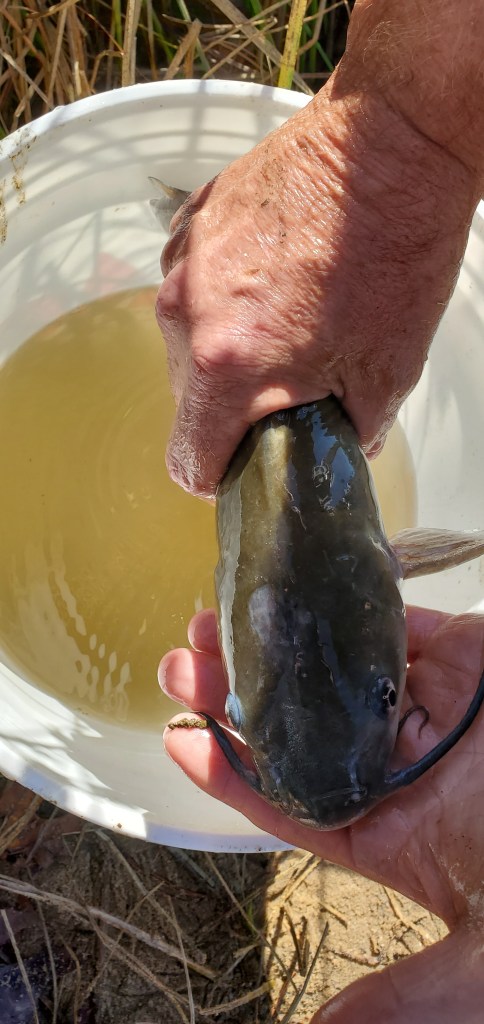
Local Fauna abound!
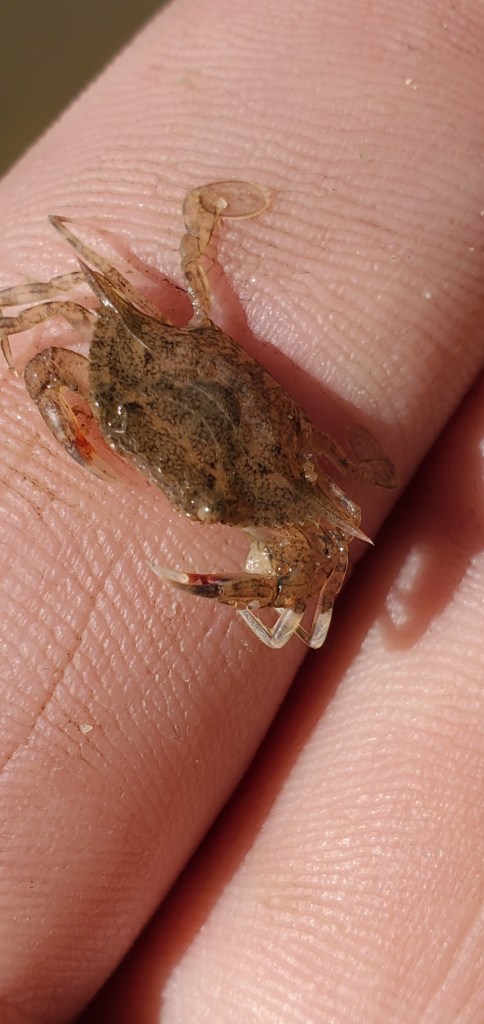
During the fish seine haul, this tiny baby blue crab was found! Blue crabs, among other animals, use the SAV beds as shelter and protection as they’re growing up. This little crab will continue to shelter in the SAV until it’s large enough to fend for itself.
Huge Mat of Hydrilla!
September 3, 2019
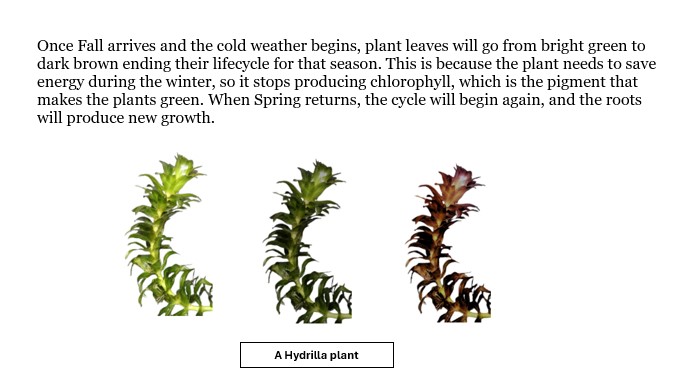
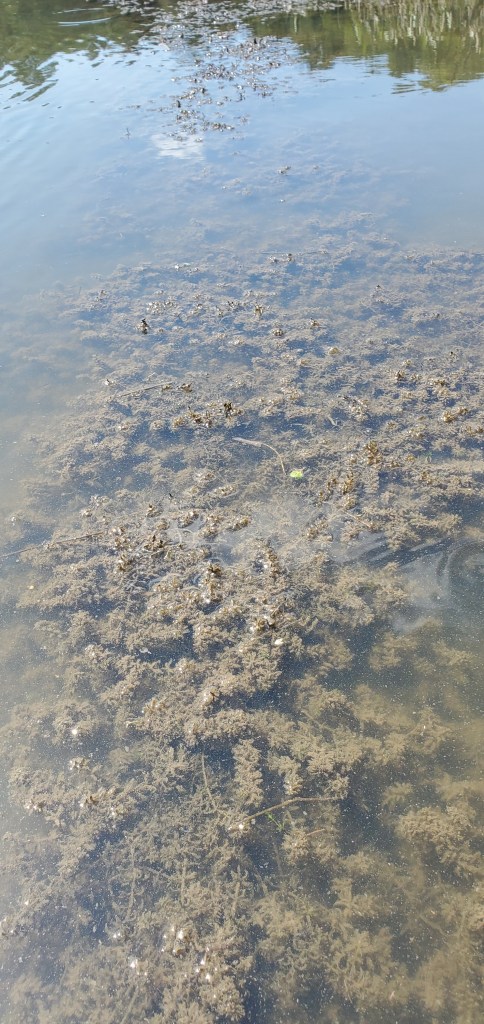
While on our pre-season survey, the CHESPAX staff found this massive mat of Hydrilla around the end of the creek! Note how that, even though Hydrilla is an invasive species, it’s still cleaning up the water.
Spring 2019 SAV Updates
And the data is in for our Spring season! Compared to the Fall, there were several very interesting points of data here! Horned Pondweed took over as the most frequent species of SAV that we found while out on our trips, replacing Hydrilla in the Fall!
Why might this be? As it turns out, temperature of the water! Horned Pondweed likes the cooler water that’s present during the Spring season, coming off of winter, and grows the best in that temperature. Once things start heating up in the Summer and Fall, the Horned Pondweed dies back a little bit, giving Hydrilla a chance to grow and spread all over everything.
So temperature has a very important effect on the species of SAV that we can find in the creek. The average temperature of the water during the Spring was around 20 C (which is about 68 F). That sounds like a pretty nice day outside, but for water temperature it’s actually in the slightly colder range.
Another interesting factor was the Secchi Depth of the creek this Spring, with an average of 30 cm (almost 12 inches, so only a foot!). Sunlight was only getting around a foot deep into the creek, which was most likely thanks to weather that we had over the end of the Fall and Winter, stirring up sediment and dirt in the water and stopping the sunlight from getting very far down.
All these factors have an impact on the species that we’re able to find. You can see the entire data set below as to which species we found on the trips! Thank you all so much for all your help. We couldn’t do it without you learning scientists!
| 0-1 | 1-2 | 2-3 | 3-4 | 4-5 | 5-6 | 6-7 | 7-8 | 8-9 | 9-10 | Overall Total | Frequency (Out of 45 Surveys) | % of Total Found | |
| Coontail | 3 | 1 | 1 | 3 | 1 | 2 | 1 | 5 | 3 | – | 20 | 44% | 19% |
| Curly Pondweed | 0 | 0 | 0 | 0 | 0 | 0 | 0 | 0 | 1 | – | 1 | 2% | 1% |
| Wild Celery | 0 | 0 | 0 | 0 | 0 | 0 | 0 | 0 | 0 | – | 0 | 0% | 0% |
| Common Waterweed | 0 | 0 | 0 | 0 | 1 | 0 | 0 | 0 | 0 | – | 1 | 2% | 1% |
| Slender Pondweed | 0 | 0 | 1 | 0 | 0 | 0 | 0 | 0 | 0 | – | 1 | 2% | 1% |
| Hydrilla | 2 | 2 | 4 | 6 | 3 | 4 | 4 | 5 | 2 | – | 32 | 71% | 31% |
| Horned Pondweed | 2 | 5 | 6 | 7 | 4 | 6 | 5 | 5 | 3 | – | 43 | 96% | 42% |
| Naiad | 0 | 0 | 0 | 0 | 0 | 1 | 0 | 0 | 1 | – | 2 | 4% | 2% |
| Southern Naiad | 0 | 0 | 0 | 1 | 1 | 0 | 0 | 0 | 0 | – | 2 | 4% | 2% |
| Total Found Per Section | 7 | 8 | 12 | 17 | 10 | 13 | 10 | 15 | 10 | – | 102 | ||
| Species Richness | 3 | 3 | 4 | 3 | 5 | 4 | 3 | 3 | 5 | – |
SAV Fall 2018 Survey Data
Here’s all the compiled data for our Fall 2018 survey season! A few interesting results that we noticed while going over the data set were the abundance of Hydrilla in our creek. We found the species almost every single time that we went out onto the creek! We only found one Curly Pondweed, but Coontail was prolific during this season!
We can’t wait to see what we find for the next season and a huge thank you to all the students that helped us out with this survey!
| Species | Site 0 to 1 | Site 1 to 2 | Site 2 to 3 | Site 3 to 4 | Site 4 to 5 | Site 5 to 6 | Site 6 to 7 | Site 7 to 8 | Site 8 to 9 | Total SAV Observed | Frequency (In 47 Surveys) | % of Total SAV Found |
| Coontail | 2 | 5 | 6 | 5 | 2 | 6 | 6 | 4 | 2 | 38 | 81% | 37% |
| Curly Pondweed | 0 | 0 | 0 | 1 | 0 | 0 | 0 | 0 | 0 | 1 | 2% | 1% |
| Wild Celery | 0 | 0 | 0 | 0 | 0 | 0 | 0 | 0 | 0 | 0 | 0% | 0% |
| Common Waterweed | 1 | 0 | 5 | 2 | 0 | 1 | 3 | 0 | 0 | 12 | 26% | 12% |
| Slender Pondweed | 0 | 0 | 0 | 0 | 0 | 0 | 0 | 0 | 0 | 0 | 0% | 0% |
| Hydrilla | 2 | 7 | 10 | 5 | 2 | 8 | 6 | 4 | 2 | 46 | 98% | 47% |
| Horned Pondweed | 0 | 0 | 0 | 0 | 0 | 0 | 0 | 0 | 0 | 0 | 0% | 0% |
| Naiad | 1 | 2 | 2 | 1 | 0 | 0 | 0 | 0 | 0 | 6 | 13% | 6% |
| Species “Richness” | 4 | 3 | 4 | 5 | 2 | 3 | 3 | 2 | 2 | |||
| Total Observed at Site | 10 | 17 | 27 | 19 | 6 | 18 | 18 | 10 | 6 | 103 | ||
| No SAV Foumd | 0 | 0 | 0 | 0 | 0 | 0 | 1 | 0 | 0 | 1 | 1% |
That’s A Wrap, Folks
October 29, 2018
2018’s 7th grade Chespax trips have wound to a close after a windy day out on the water. But what does that mean for everything creek and data related?
Coming up in the next few days there will be compiled and completed charts and graphs and tables detailing how well the creek did this Fall 2018 season!
So stay tuned for some awesome data!
Whether the Weather Matters
October 19, 2018
When we think of plants and creek health, weather isn’t always the first thing that comes to mind as a factor. Trees might get blown over in the wind or knocked over in the rain, but how would that affect the SAV down at the bottom of the creek?
Storms actually have a pretty big effect on the SAV population in the creek. All the wind and rain cause sediment from the shoreline to be pushed into the creek, increasing the turbidity and generally clouding up the water. This cloudiness causes the SAV to be unable to get the right amount of sunlight that they need to perform photosynthesis, making it so that they can’t flourish and survive.
These large storms can cause large currents as well, making it so that the SAV holding onto the bottom of the creek is ripped out of the ground and pulled downstream. The currents can also pull out all the seeds that were sowed by the SAV for the next season. A bad storm can have quite the impact on the SAV beds in our creek! In fact, in Fall of 2011, two large storms came through the area, causing pretty bad flooding for the county. When the 7th graders went out on the SAV trips the next year in 2012, they didn’t find much SAV at all! The storm had ripped out all the roots and all the seeds, leaving the creek almost bare.
The silver lining on all of this is that our creek is resilient, meaning that even if something bad like a storm happens, the creek always has the ability to bounce back and recover from disasters
The State of the Creek Address
October 11, 2018
For over a month now, 7th graders with Calvert County Public Schools have been going out onto Cocktown Creek, just off of the Patuxent River by Kings Landing Park, to survey and observe how the creek is doing with its health. As more results are coming back, a better picture of the creek is coming to light and the distribution and health of SAV can be more clearly seen.
Overall, the most common species in the creek so far is the invasive Hydrilla (Hydrilla verticilliata), with every trip out onto the creek coming back with multiple boats finding a sample of the species. While it’s good that SAV is being found this commonly, Hydrilla is an invasive species, having pushed out the once abundant native species, Wild Celery. Unlike years past, however, the students haven’t found the large, choking mats of it that were found previously near the back of the creek.
Another species commonly found in the creek so far has been the Coontail (Ceratophyllum demersum). Most boats come back with a sample of Coontail, with only two or three trips not finding any. Like the Hydrilla, the Coontail can be found throughout the creek, but so far seems to be most common in the middle sections.
The other species of SAV, like the Naiad and Common Waterweed, are less common than both Hydrilla and Coontail, but can still be found in certain areas of the creek. So far Naiads, Common Waterweed, and a single Curly Pondweed have been found by the students!
All in all, in terms of SAV, things aren’t looking as bad as they have been back on Cocktown Creek. We eagerly look forward to seeing what is discovered in the next few weeks by the 7th graders!




Like a Needle in a Haystack (Baystack??)
A first for Chespax was found last week with Ms. Liston’s class of 7th graders during the seine haul done along our beach!
This is an Atlantic Needlefish (Strongylura marina), a fish commonly found in the lower bay that preys on smaller fish.
What was it doing this far up the Patuxent? With all the wind and weather that we’ve been getting lately, there’s a high chance that this fish might have been caught up in a current that brought it all the way to our net! Let’s hope that it found its way back to the Bay proper!
A Very Neat Find!
September 27, 2018
Yesterday on their SAV survey, Ms. Liston’s 7th grade class from Windy Hill Middle School found an impressive find! Curly Pondweed, one of our native types of SAV, has not been found this year during our surveys, so seeing it yesterday was a very welcome sight!
Curly pondweed can be identified by the wavy edges of the leaf, and while not an important food source for local wildlife, still provides great hiding spots for young fish and shrimp, as well as helps keep sediment out of the creek!

Fish Species and What They Can Indicate
September 24, 2018
What comes to mind when you think of water? Probably one of the first things is fish, or at least fishing. Our 7th graders that have been coming on the Chespax trips to King’s Landing Park get to do just that during their visits. Using waders and a seine net, groups of four go into the water and bring back what they can catch.
Here are some of the fish that have been found by the classes that have gone out!


But what does finding all these fish mean for our SAV and the health of the creek? We pulled up juvenile Rockfish (or Striped Bass for those of you who know it by that name), which can indicate that there is an abundance of smaller fish for the Rockfish to prey upon! An abundance of smaller fish means that the SAV beds must be doing good as well, since those smaller fish depend on the SAV for shelter and food. So by pulling up predator fish, like Rockfish and White Perch, we can make the conclusion that the SAV beds must be healthy, otherwise we wouldn’t see those larger fish!
What Does Rain Mean for SAV?
September 17, 2018
With what remains of Hurricane Florence bearing down on our location at King’s Landing Park, what does this mean for the SAV and creek?
When it rains heavily, what can happen are a few things that affect SAV. First, heavy rains can bring with them lots of run-off, including phosphorites, fertilizers, other chemicals from farming or lawn care, and loads of soil and silt. Chemicals in the water can influence algae growth, which will block the sunlight from getting down into the water, as well as create dead zones in the water after the algae dies. Silt and soil can also clog up the water, making sure that sunlight can’t reach down to the SAV that needs it to grow.
Rain also changes the water chemistry of the creek. Inundation of fresh water into the creek will lower the salinity, sometimes almost to zero parts per thousand (ppt) at the back of the creek! While some SAV, like the Naiad, thrive in fresh water, other species need just a little bit of salinity in order to grow.
So how will the upcoming rain affect the SAV in the creek? Will we see more Naiad species or will there be less overall? Stay tuned for updates as we head out again for another survey!
An Interesting Find!
September 13, 2018
The first students have gone out onto Cocktown Creek to aid in our survey of SAV! The 7th graders all headed out on their canoes upstream, stopping at two separate locations to survey the SAV there. Hydrilla was the most commonly found, with every boat in both groups finding the species, followed by some Coontail, found by all boats in the second group. Common waterweed was the next most common one, found by a number of boats in the second group, closer to the mouth of the river.
There was, however, an interesting find while the second group was moored for their lunches. A piece of Naiad, found floating close to where they stopped! Unfortunately for our data, that piece was unable to be counted as part of the survey, as we didn’t know where it had come from or what section of the creek it could be found.
Other fun finds included an osprey, a bald eagle, a red-bellied turtle, a really cool looking grasshopper, and a few laughing gulls out on the Patuxent! Make sure you stay tuned for any more interesting finds or cool stories that happen over the course of our trips!
Gearing up for Survey Season!
September 12, 2018
It’s a little over a full week since school started and you know what that means? 7th graders from around the county are going to be making their way to King’s Landing Park to participate in CHESPAX’s annual SAV Survey! Each 7th grade science class will be headed out onto the waters of Cocktown Creek, canoeing down it to see what kind of SAV they can find.
These science classes not only get to canoe, but also will be participating in several other activities helping assess Bay health. The students will be seining for fish and invertebrates, testing water quality, among other activities. How do you think the Bay is doing? Keep up to date with the findings and stories right here!
Fall (2018) Preliminary SAV Survey
September 6, 2018
The Sun beat down overhead as we rowed out onto the Patuxent, heading for the mouth of Cocktown Creek in the sweltering heat and humidity of the early morning. Despite the heat, the mood was already set high thanks to a pair of Bald Eagles being spotted merely minutes into the trip. Fish leaped from the water, shad and other species we didn’t see long enough to ID, either hunting or escaping our canoe as it traveled further into the creek. Kingfishers cried out overhead and even the occasional osprey!
But this trip was about the SAV, finding it and seeing how things looked in the creek before the students begin arriving next week. Hydrilla verticillia (also known as Hydrilla) is an invasive species of SAV that’s pretty abundant in the creek now. We found quite a bit of it, even more the further away from the mouth of the creek that we traveled. Hydrilla was found at the back of the creek in large mats, covering almost a quarter of the width of the creek.
But Hydrilla wasn’t the only species of SAV that was found during the preliminary survey. Common Waterweed(Elodea canadensis) and Coontail (Ceratophylum demersum) were both found in smaller quantities along the other markers on the creek.

Outside of a tree that was down about midway up the creek, we were able to progress with little to no difficulty, so conditions should be perfect for the students when they arrive! We’re all looking forward to what they are going to find when they’re out there surveying!
Spring SAV Surveys Come to a Close
June 4, 2018
The 2017-2018 school year has been notable for our 7th grade SAV surveys. This year has shown a decline in SAV, both in diversity and quantity. This was clear in the fall and continued into the spring. While cold temperatures seem to be part of the problem, the experience of the teachers at CHESPAX tells them that there are other factors at work. Water clarity is certainly a problem, but that like is a result of the declining SAV, not the the cause.
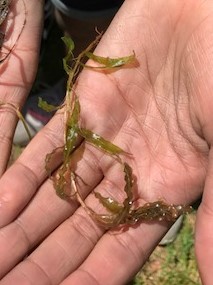
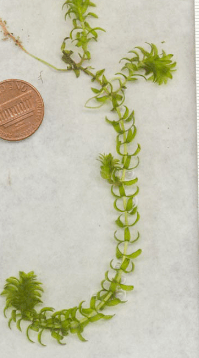
Interestingly, in this very slow season with many ‘no SAV found’ surveys, a species of SAV was found one time that had NEVER been found on Cocktown Creek in all the years of this survey. On May 21, 2018, the students from Ms. Skiados’ class that were in Ms. Popernack’s canoe found a specimen of Southern Naiad (pictured below). Finding this species gives hope that maybe with the decline of hydrilla, some native species may find their way back into our creek.
Right now we are not able to pinpoint the exact cause of the SAV decline, however, the ongoing nature of this survey allows us to create the big picture over time. By comparing this year’s data to past years and upcoming years, we may be able to piece together the likely causes of the decline, and hopefully see the SAV bounce back quickly.

If you have any thoughts on the water clarity or surprisingly low SAV numbers, let us know! You can view this year and historic data on the CHESPAX website: www.calvertnet.k12.md.us/departments/instruction/instruction_program_information/chespax/sav_page/
The Wildlife
May 22, 2018
SAV may be the focus of our 7th grade survey, but no trip to Kings Landing would be complete without noting the wildlife both in the water and around the shores! Our birds around the river and creek have been abundant with bald eagles, ospreys, and cormorants being seen regularly. Northern water snakes and turtles are a common sight on sunny days, and the fishing has picked up in the past week! Below are some of our favorite finds this spring!


It may look like SAV…
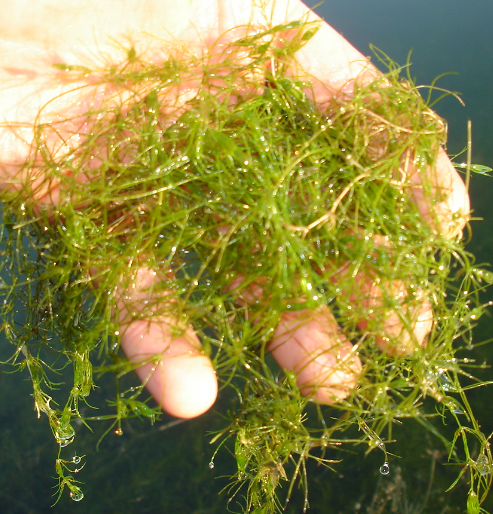
This week at CHESPAX we were very excited thinking we had found another species of SAV in Cocktown Creek. The green beauty pictured above was found by multiple canoes within a group and seemed to fit the qualifications for SAV. However, upon further inspection we realized we’d found another type of algae known as Muskgrass. This type of algae is often mistaken for SAV, but lacks true leaves, stems, or roots. While not what we were hoping to find during our survey, it does serve some purpose as it provides good to excellent food value for waterfowl.
Slow spring for SAV
May 15, 2018
It’s been a cold spring (snow days in late March ring a bell?!). Just like the slow start to spring, we had a slow start to our SAV surveys! CHESPAX had to delay the start of 7th grade canoeing trips by more than a week, and even then, we came up with no SAV for the first few trips. Slowly, the horned pond weed is starting to be found on a regular basis but has yet to be found by every canoe in a group as is typical for late spring. Additionally, only 2 (Coontail first and recently Hydrilla) other species have been found indicating potentially low diversity of SAV species. After surveying the creek multiple times we can say with confidence that this isn’t normal! So what in Cocktown Creek is going on here?!
Weather watch!
Our little creek’s SAV species like just the right temperature, not too cold, but not too hot. The water temperatures have been lower than normal, which leads us to believe that maybe the SAV are just getting a slow start this spring and once we have consistently warm weather we will see significant growth. However, as we observed last fall, sediment continues to be a big problem. Our secchi depth readings are low and our turbidity is high. If the water is murky and the SAV cannot get sunlight, they will not grow well. On the flip side, SAV helps reduce the sediment in the water, so it can be hard to solve the sediment issue without the SAV.
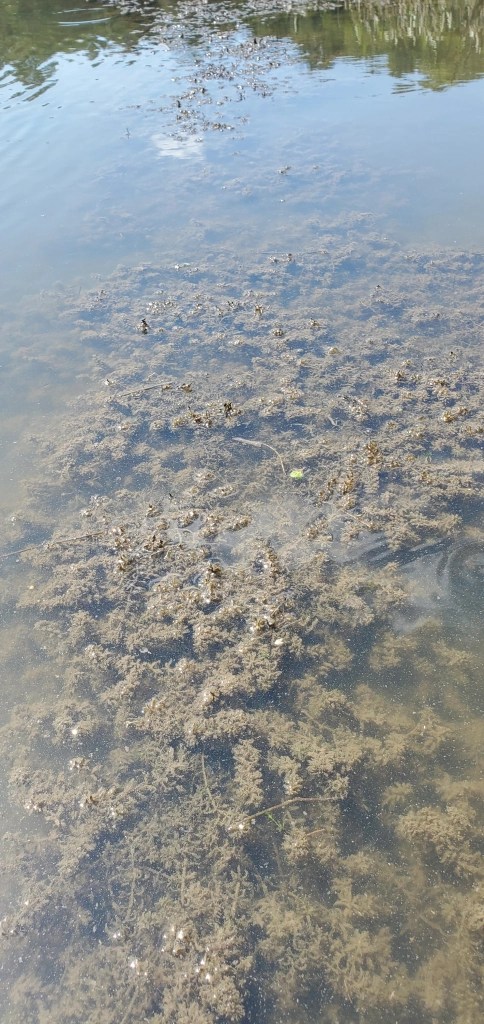
Below is a picture of Cocktown Creek where SAV (particularly hydrilla) was once abundant. We have noticed a significant decline in the 2017-2018 school year.
Scientists say…
CHESPAX has spoken with other scientists researching around the bay, and they’ve asked about our salinity levels over the 2017 summer. High salt levels in the summer can lead to poor hydrilla growth in the following seasons, and we definitely noticed a decrease last fall that has continued to this spring. Unfortunately, we do not monitor water quality in our creek over the summer, but some continuous monitoring stations along the Patuxent River indicate salinity could have been a factor (http://eyesonthebay.dnr.maryland.gov/ ). Amidst reports of increased bay grasses around the Chesapeake, we find our lack of SAV even more puzzling. However, the problem does not seem contained to our creek alone. Check out this article about Anne Arundel SAV http://www.capitalgazette.com/news/environment/ac-cn-no-grasses-20180510-story.html.
Keeping track!
Although each 7th grader is only out here for one day, their data is incredibly important to scientists tracking the health of the Chesapeake Bay. Citizen scientists are collecting data all around the bay and tracking information. This data is compiled and allows scientists to track SAV and water quality. As they start noticing trends they can predict what the causes might be. If you have a hypothesis on what’s causing the SAV decline, share it! We’d love to hear your thoughts.
Calvert County 7th Graders Make a Difference!
The Daily Press reports that ‘anti-pollution’ efforts in the Chesapeake Bay are working to restore submerged aquatic vegetation (SAV)! The article sites an ongoing study that has tracked SAV since 1984 – this is what our 7th graders from Calvert County contribute to! The information collected by our 7th graders each year is submitted and being used to prove that our save the bay efforts are working and making a positive impact on the health of the Chesapeake Bay. Click the picture to read the full article.
SAV Biodiversity
SAV beds are in global decline, and scientists are working to halt (and reverse) this trend before it’s too late. It looks like species biodiversity may hold promise for replanting these beds. Check out this article from Science Daily!
www.sciencedaily.com/releases/2017/11/171108131836.htm
Fall 2017 SAV surveys are complete!
Thank you to all the students, teachers, and chaperones who came out to Kings Landing! We wrapped up a strange fall season on Halloween. As we look at the data, many questions arise concerning the status of Cocktown Creek, and our section of the Patuxent River.
As mentioned in previous posts, the number one thing that has jumped out at us this fall was the lack of Hydrilla in the creek! Not long ago, the masses of Hydrilla were so thick in some areas that a canoe could not pass through. This fall, there were days where not even a single canoe team found a specimen of Hydrilla. The Naiad species also took a noticeable drop from recent fall seasons. To pile on to the declining SAV numbers, there were five trips in which canoe teams went out and did not find a single piece of SAV!!!
Even more puzzling, is the increase in Common Waterweed. Despite its name, this SAV species was once a rare find on Cocktown Creek, but it was found by 40% of canoe teams this season! For the first time in recent memory, we had relative abundance scores of “3” for Common Waterweed. Could the drop in Hydrilla be allowing this native species to thrive?
Other areas of the Patuxent River have had marked improvements this year, both to the north and south of Kings Landing. However, in our section we had poor water quality, as seen through high turbidity numbers and low secchi depth readings. In fact, water clarity has not been so low since 2012 after Tropical Storm Lee and Hurricane Irene.
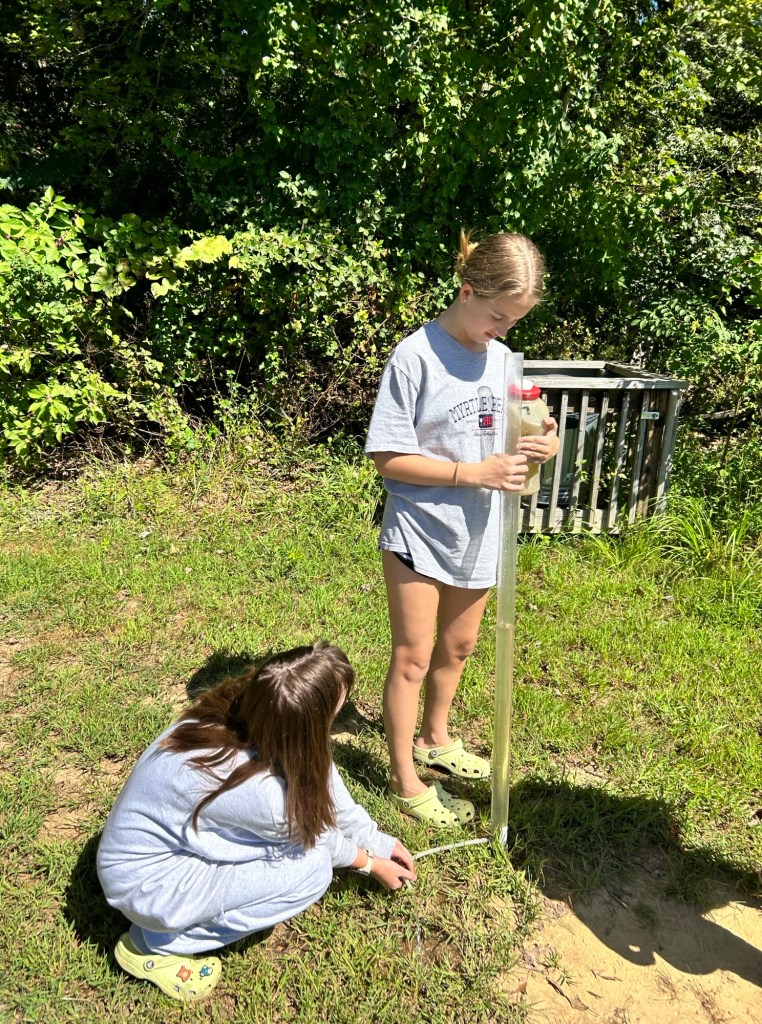
Our SAV data is just one piece of the puzzle as scientists look at the health of the Chespeake Bay and surrounding bodies of water. An interesting piece of the puzzle has been observed by our 7th graders this fall. Our data brings up some interesting questions. Has the decline in Hydrilla been caused by poor water clarity? Or, do we have poor water clarity due to the decline in Hydrilla? We know that an important function of SAV is to clean the water. Without SAV, sediment moves freely as seen in the picture below taken by a drone near marker 4 on Cocktown Creek.
Have there been other factors contributing to the low amounts of SAV, such as an increase in salinity or summer storms? As our classes turn in the data from fall surveys to the US Fish and Wildlife Service, and others around the Chesapeake Bay contribute their information, perhaps we will gain insight as to what our piece of the puzzle means. We do know that if we can work to increase water clarity, we should have thriving SAV beds, abundant wildlife, and ultimately a healthy ecosystem.
Check it out!
While we are having some unusual observations this fall on Cocktown Creek, there is positive news from the shores of Solomons! Check out this article from Chesapeake Biological Lab.
www.umces.edu/news/bay-grasses-return-shores-solomons-will-they-persist
Fall SAV Trip are Underway!

September was a busy month, and our groups have explored every part of Cocktown Creek at least once, making some interesting observations.
*One of the most notable observations so far is the lack of Hydrilla in the creek. In past seasons, this SAV species was abundant and found in every part of the creek. This season it is somewhat of a rare find and is sparse where it is found.
*Along the same lines, there has been a low density and low variety found throughout the creek, with Coontail being the most commonly found SAV.
*There has been a specimen of Horned Pondweed found this month, which is unusual for the warmer waters of fall.
*On a positive note, the wildlife sightings have been wonderful with Bald Eagles, Osprey, Red Bellied Turtles, Great Blue Herons and water snakes being spotted on multiple trips.
*Our Seventh Grade fishers have also come up with a variety of species in their seine hauls including the interesting Hogchoker seen here.
The data collected from Calvert County seventh graders will be compared to data around the Chesapeake Bay area to see if other areas are having similar observations or if it is confined to a small area. Information on the water quality may start giving us insight into the reasons for low SAV counts. While temperature may be slightly on the high side, algae and turbidity readings are right around average. The visibility is low in the water as shown through low Secchi depth numbers. It will be interesting to see how the story plays out this fall as each seventh grade class adds another piece to the SAV puzzle.
Spring Surveys Are Complete!

From the entire CHESPAX Staff, we want to say Thank You for another great season out on the Creek. It was a windy season, and the transparency tube measurements were just a bit lower than seasons past. The interesting story is that of Horned Pond Weed. As shown above, the seventh graders found Horned Pond Weed less than 50% of the time, quite a decrease. Additionally, the usual “horns” – flowering parts of the plant- were not evident even once from all that were collected. This was a first in our CHESPAX memory! Overall, the Bay Journal reports that the SAV in the Bay region is doing well, so we look forward to seeing what next school year brings. Link to Bay Journal article
The seventh graders collected many Shad and Croaker this season, these numbers seem to ebb and flow over the years.
Spring (2017) is Here!


Our seventh graders have been out on the Creek and their data has a story to tell. They have completed almost two cycles on the creek. It is what we are NOT finding that is the story. The students are finding that Horned Pondweed is very scarce compared to past years. Hydrilla is still relatively abundant and they even found a few samples of Curly Pondweed (pic. above). Could the lack of Horned Pondweed be due to low temperatures? The Turbidity (secchi depth) readings have been very low, averaging under 30 cm—very far from the optimal 100 cm target, let’s see what the rest of the season brings. We had a Rough Greensnake cross our path, and Mr. Harten was kind enough to let the students get to see the snake up close.
Here is a link to this season and past years’ data. If any class can look at the years past and compare water temperatures or if they have a different hypothesis of why we are low on Horned Pondweed this year, let us know and we will post their findings here.
Don’t forget to keep checking the OSPREY CAM – the eggs should begin hatching in a couple of weeks.
~See you on the Creek,
CHESPAX Staff
Fall 2016 Field Updates
The Fall 2016 SAV survey season ended on Halloween. Not surprisingly, Hydrilla was the most abundant species found throughout Cocktown Creek. The seventh graders’ data showed that the diversity of species, especially in the back part of the Creek, has dropped significantly over the past several years. Where we used to collect 6-7 species, we are only finding 1 or 2. This change impacts our feathered friends who are dependent upon our native species for their nutrition. It was encouraging that the seventh graders found many samples of Common Waterweed this season and we look forward to seeing if this turns into a pattern in the spring.
In looking at water quality, the data suggests the SAV is struggling for sunlight. In Vivo Chlorophyll (ug/l) averaged out at 36, 24 & 23 for the front, middle and back of the creek respectively. We like to see the numbers < 25. Turbidity (NTU) was 19, 15 & 13, close to zero is ideal. The Sechhi Depth (cm) readings averaged at 25, 33 & 42, but >100 cm is optimal for healthy SAV growth. Look at the chart above to see how your class trip compares to this season’s averages.
The fish data shows that we continue to get a variety of species, with two American Eels caught this season. The largest catch of the season goes to Windy Hill Middle with over 3,400 Grass Shrimp caught during the 8 seine hauls.
See you in the spring of 2017 ~CHESPAX Staff
Email us if you would like receive the Excel files for this season
Fall 2016 SAV data, fish data, water quality data & past data
Spring 2016 Field Updates
May 3, 2016
Bay Grasses increase 29% in Maryland Waters
“Underwater grass abundance increased 29 percent between 2014 and 2015 in Maryland waters, indicating an improvement in water quality, according to the Department of Natural Resources.The vegetation growth hit a new record, 52,277 acres, putting the state at 94 percent of its 2017 goal of 57,000 acres.”
Fall 2015 Field Updates
October 27, 2015
When both groups entered Cocktown creek, they were greeted by an unfamiliar face. It is hard to tell if this morning greeting was a male or female. Beavers are almost identical from male to female. Nonetheless, it was a great surprise and photo opportunity. I hope to see more animal encounters next spring when we continue to search for more SAV

October 22, 2015
Have you ever wondered how you could help the growth of SAV? A group of Volunteers are in the process this year to help the regrowth of Wild Celery.

September 14, 2015

Mrs. Thames class from Northern Middle School found a wide variety of S.A.V. including Coontail, Naiad, Hydrilla, Common Waterweed and WILD CELERY. We are excited to have a great example to show in the classroom to all the other classes. Here’s hoping for a great year and more opportunities to find Wild Celery.
Spring 2015 Field Updates
Horned Pondweed S.A.V. is like the daffodils of the spring time. When you walk around and see daffodils budding and flowering you know spring has come. That is the same way it is on the water when Horned Pond weed is found. Horned Pondweed grows slim leaves that are thread like. It can be easily confused with Slender Pond weed. Horned pond weed has distinctive horned seeds on the leaves.

Just like us, the birds are looking forward to spring. Soon, Ospreys will be joining the residential bald eagles. I have seen a rise of bald eagles and usually spot them throughout the county along route 4 soaring in the sky. Recently, there has been a study how Hydrilla, a Submerged Aquatic Vegetation (S.A.V.), is affecting birds like the Coot that eats the Hydrilla, which releases a brain altering toxin. This nuerotoxin affects the bird where it becomes an easy prey for the Bald Eagle. However, the Bald Eagle could be affected by this toxin by developing a deadly disease in their system. For more information check out this link.
Fall 2014 Field Updates
October 31, 2014
As we end up our fall season I wanted to leave you this this wonderful picture from today.
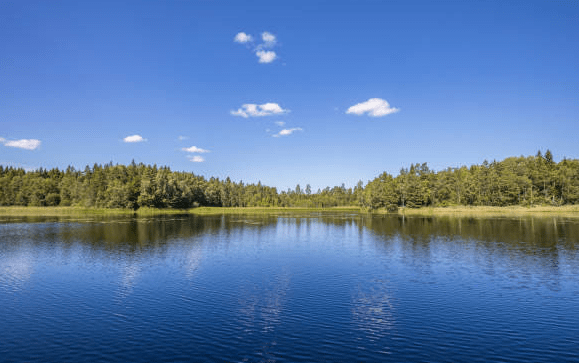
The Smart-Board file map, and other documents will be uploaded here shortly. Here’s to a great winter and more clarity come springtime.
October 21, 2014

Dr. Curry, the new superintendent of Calvert County Public Schools joined Mr. Roth’s 7th grade class from Southern Middle School on their CHESPAX Field Trip. Dr. Curry tweeted his thoughts and sights throughout the day.
My first CHESPAX event today. Very exciting. Hope I don’t fall in the water and soak my camera. http://t.co/uxP3wXAmev— Daniel D Curry (@CalvertSuper) October 21, 2014
October 23, 2014

Today may mark the end of an era. The elusive and mysterious wild celery made an appearance on Cocktown Creek today around marker #8. A piece was scraped up by a student from Calvert Middle School in Mrs. Campbell science class. The tide was extremely low which is why this patch has not been seen yet this school year.
Could this be the beginning of the return of the Wild Celery SAV? Only time will tell. For now we are delighted to see its return. The piece was small, and was an unofficial collection. We are still determining if it was Wild Celery or a piece of marsh grass.
October 9, 2014

Today students from Calvert Middle School, Mr. Marick’s class, caught an American Eel while seining for fish. This snake-like creature is actually a fish. While eels are rarely caught by our 7th grade classes during our fish surveys, when we do it’s always an exciting catch!
Eels are one of the fish that are commercially harvested from the Patuxent River, primarily shipped overseas to markets in Europe and Asia.. The expression, “slippery as an eel”, is based in truth as eels are coated with a thick slime that makes them very difficult to hold on to.
September 5, 2014
We wrap up our first week of trips with a trek all the way past marker 9 with Mrs. Thames class from Northern Middle School. The SAV is growing so well it makes paddling through it a workout. The clarity of the water is excellent with 111 c.m.(average).
October 23, 2014
Here is a fish we don’t normally catch while seining.

The name “croaker” comes from the odd croaking sound that is emitted when the fish are handled. All members of the drum family of fishes have an air-filled sac which is quickly vibrated to create this odd noise. Croakers will feed upon any small bay animal they can catch, but different types of worms and invertebrates make up most of their diet.
October 21, 2014
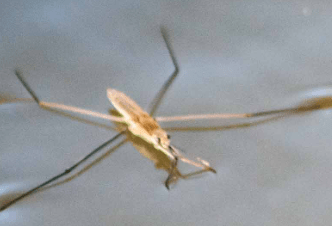
Here is something we found during our Seine Fish Haul. It isn’t a fish but an insect called a Water Strider.
Water strider’s are about a half inch long with a thin body and three sets of legs. A water strider’s front legs are much shorter than the two sets of back legs. The shorter legs are used for catching and holding onto food. Water striders eat insects and larvae on the surface of water, such as mosquitoes and fallen dragonflies.
Check out this link for more information about Water Striders
September 10, 2014

Mr. Roth from Southern Middle School joined his students in the water while seining. It is always great to see teachers come to this CHESPAX field trip and getting involved in the Field Experience while having fun.
August 28, 2014

All of the staff went out on an early paddle before trips start in the upcoming weeks. To our surprise we found some Wild Celery growing in the back of the creek. We are hopeful for its return. This is the first sighting of Wild Celery in Cocktown Creek. There were Bald Eagles, Ospreys, Hawks, Kingfishers, Red Bellied Turtles and water snakes.
Spring 2014 Field Updates
April 26, 2014
Recently, the Bay Journal has reviewed SAV from last year and has found that SAV has increased 24 % in 2013.
According to the Bay Journal (Blankenship, 2014), “After three years of sharp declines, acreage of ecologically important underwater grasses bounced back last year, increasing 24 percent in the Chesapeake Bay and its tidal tributaries over the amount observed in 2012.
Still, beds of submerged aquatic vegetation, or SAV, remain far below their average of the last three decades, and scientists are concerned that most of the comeback consists of widgeon grass, a species notorious for large year-to-year fluctuations.”
May 8, 2014

Due to the amount of rain and Duckett’s dam in Laurel, Maryland releasing water the water level is higher than normal the past few days. There is a lot of debris floating down the river. While out recently we found a baby snapping turtle floating on the surface of the river. We are seeing other wildlife with nearby ospreys nesting, muskrats along the creek, Bald eagles, Great Blue Herons, wood ducks, and snakes.
This storm and the amount of sediment may affect the health of the SAV. However, it is early in the season and hard to tell how it will affect the new growth of the SAV.
Fall 2013 Field Updates
October 29, 2013
Today was a record setting day for grass shrimp. Both classes combined caught over 500 grass shrimp. Mr. Pellock’s group was here and pulled in the grass shrimp by the loads.
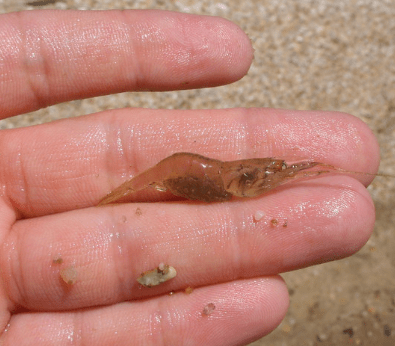
The water and air are getting cooler. Some of the fish and crabs have been declining due to the colder water.
October 15, 2013
Mrs. Campbell’s class from Calvert middle school explored between marker number 9-10 today.

It was a beautiful sunny day where students journey through the back of Cocktown Creek. The back section of the creek is one of the most surprising areas to see in comparison to last year. There was no sight of SAV last year, however this year it is quite the opposite. The Secchi Depth was 118cm on average (image on left).
October 24, 2013
Round 5 of the markers was completed today. Please see attached the SAV data for the Fall 2013 SAV season. You can find it under the SAV tab. It was a really better year out there on the creek in comparison to last year. Our numbers are increasing, even when compared to the Fall of 2012. Our best turbidity observation was 100 cm, which is mainly the back of the creek.
Our fish data is also increasing with diversity. We are catching some larger Spot Tail Shiners and even a Northern Pipe fish!
October 4, 2013

We have completed the third round of surveys for Cocktown Creek. Many plants are growing in the creek including Hydrilla, Coontail, Naiad, and even some Horned Pondweed. Students and teachers are finding a different picture than was found last year. Hydrilla is still the most common type of SAV found. The seine surveys have been on a decline this past week possibly due to the warmer weather.
We have been catching less fish since the beginning of the season. We have caught a few catfish and kept one of them for our live tank inside our offices. Be sure to check it out when you visit. Watch out for updates on the Seine Haul Wildlife Slide Show!
September 24, 2013

Today we found Horned Pond Weed with Mrs. Miller’s class from Windy Hill Middle School. Horned Pondweed has leaves that grow opposite one another along the stem.
The Horned Pondweed has small “horn-like” seeds that grow between the leaves and the stem during the early Spring (usually).
September 16, 2013
We have finished our first week of SAV surveys for the Fall 2013 season and we have already seen an increase in SAV diversity and abundance over last year.

The creek, river and the Chesapeake Bay are still recovering from the one-two punch dealt by Hurricane Irene and Tropical Storm Lee in 2011. The huge volume of water delivered to our region by those storms resulted in a loss of water clarity and literally ripped the plants out by the roots.
 chespxblogs.com